

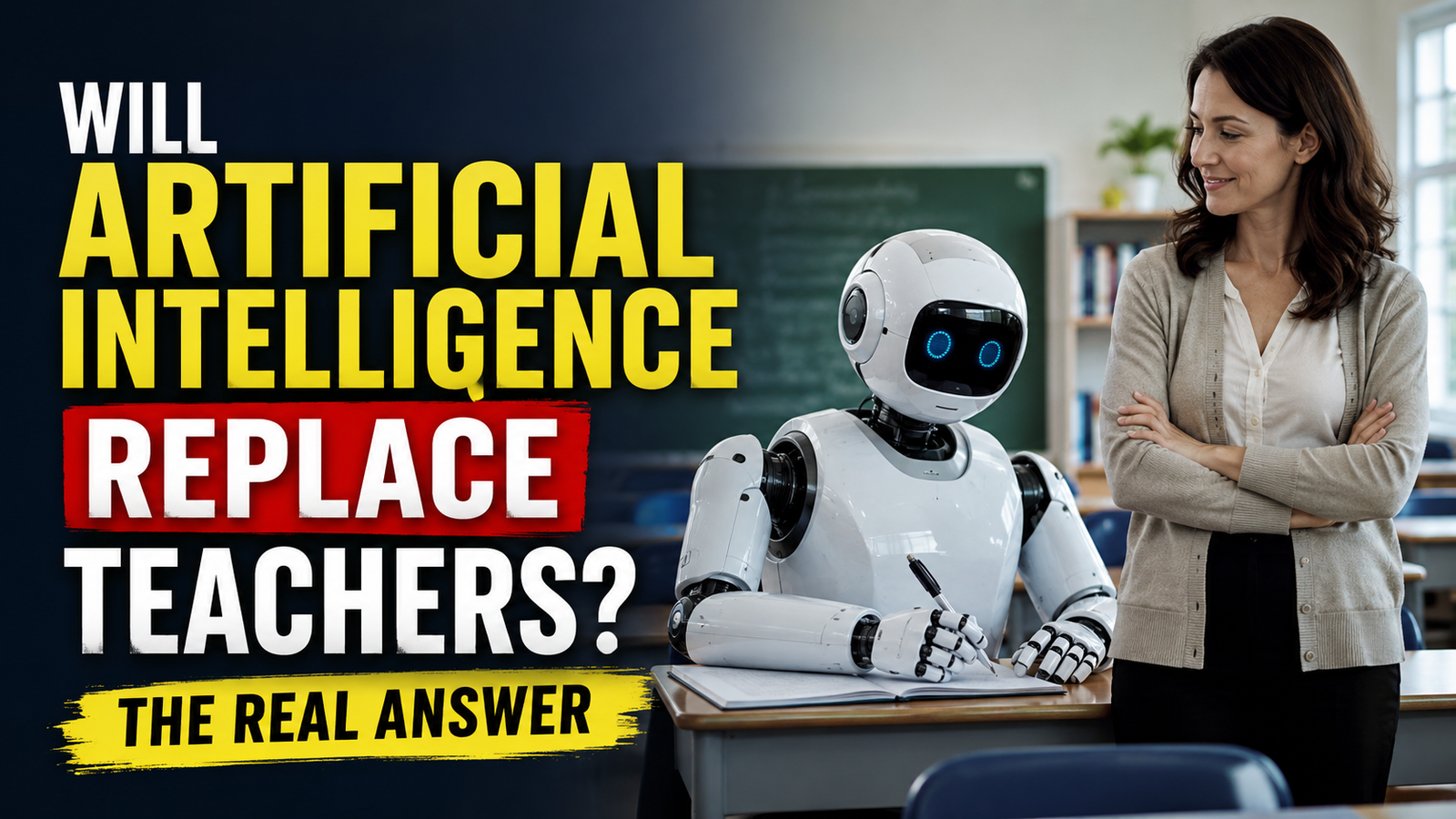
Artificial Intelligence is transforming the education landscape, bringing new possibilities through AI tutors, personalized learning platforms, and automated teaching tools. But one important question remains: Will AI replace teachers? While AI can support learning, automate repetitive tasks, and provide instant access to information, it cannot replace the human connection, empathy, and guidance that teachers provide. The future of education is not about machines replacing educators—it is about teachers and AI working together to create smarter, more personalized, and more effective learning experiences for students.
Artificial Intelligence (AI) has quickly become one of the most discussed technologies in education. From AI-powered learning platforms to virtual tutors and automated grading systems, technology is changing the way students learn and teachers teach. Classrooms that once depended only on textbooks and traditional teaching methods are now exploring smarter digital tools that can provide faster, more personalized learning experiences.
This rapid growth of AI has created an important question among educators, students, and parents: Will artificial intelligence replace teachers, or will it simply transform the teaching profession?
The idea of machines taking over teaching may sound like something from a science-fiction movie, but the reality is much more complex. While AI can perform many educational tasks efficiently, teaching is not only about delivering information. It is also about inspiration, emotional support, creativity, and human connection.
The future of education may not be about choosing between AI and teachers. Instead, it may be about understanding how both can work together to create better learning experiences.
Artificial Intelligence has introduced several powerful tools that can support both teachers and students. AI systems can analyze large amounts of information, recognize learning patterns, and provide personalized support based on individual student needs.
Some of the major ways AI is being used in education include:
AI-powered assistants can answer student questions within seconds. Whether a student needs help understanding a difficult mathematical concept or wants additional explanations about a topic, AI tools can provide immediate guidance.
This allows students to learn at their own pace and receive support beyond regular classroom hours.
Every student learns differently. Some students understand concepts quickly, while others need additional practice and explanations.
AI can analysetudent performance and recommend personalized learning materials, exercises, and resources. This helps create a learning experience that matches each student's strengths and weaknesses.
Teachers often spend significant time on administrative responsibilities such as grading assignments, preparing quizzes, tracking attendance, and organizing learning materials.
AI can help automate these tasks, allowing teachers to spend more time interacting with students and focusing on meaningful teaching activities.
AI tools can assist teachers in creating lesson plans, worksheets, quizzes, presentations, and other educational resources. Instead of replacing teachers, these tools can reduce preparation time and help educators develop more engaging lessons.
Learning does not stop when school hours end. AI-powered tutoring systems can provide additional support whenever students need help, making education more flexible and accessible.
However, while AI can assist with many teaching responsibilities, it does not truly understand students in the way human teachers do. It can process information, but it cannot replace human empathy, encouragement, and emotional understanding.
Education is not simply the process of transferring knowledge from one person to another. A great teacher influences students emotionally, socially, and personally. This human element makes teachers irreplaceable.
Teachers play an important role in motivating and encouraging students. They recognize when a student feels discouraged, lacks confidence, or needs extra support.
A teacher's words of encouragement can inspire students to overcome challenges and believe in their abilities. AI can provide answers, but it cannot genuinely understand emotions or build personal relationships.
Every student has a unique background, personality, and learning style. Teachers can identify problems that may not appear in test results.
For example, a teacher may notice that a normally active student has become quiet or that a student is struggling because of a lack of confidence. This level of understanding requires human observation and experience.
Education is not only about academic success. Schools also help students develop creativity, teamwork, communication skills, discipline, responsibility, and ethical values.
Teachers act as role models who guide students beyond textbooks. AI can provide information, but it cannot replace the human experiences that shape character.
Teachers constantly make decisions based on classroom situations. They adjust their teaching methods, handle conflicts, encourage participation, and create a positive learning environment.
These decisions require emotional intelligence and real-world understanding that AI currently cannot fully provide.
The most realistic future of education is not AI replacing teachers but AI supporting them.
When used correctly, AI can become a powerful assistant that helps teachers work more effectively.
Some benefits include:
Instead of spending most of their time preparing materials or grading assignments, teachers can focus more on mentoring students, encouraging creativity, and building stronger classroom relationships.
The future may not be AI versus teachers. The future is likely to be AI with teachers.
AI will not eliminate the teaching profession, but it will change the role of teachers.
Traditionally, teachers were often viewed as the main source of information. Today, students can access information instantly through digital platforms. As a result, teachers will increasingly become guides who help students understand, analyze, and apply knowledge.
The role of teachers will shift:
Future teachers will need digital skills and AI knowledge to effectively use new educational tools. Those who learn how to work alongside AI will be able to create more engaging and effective learning environments.
Although AI offers many advantages, completely replacing teachers with technology would create several challenges.
AI can recognize patterns and provide responses, but it does not experience emotions. Students need encouragement, understanding, and personal guidance that only human interaction can provide.
AI systems often collect and analysetudent information. Protecting student data and ensuring responsible use of technology will be an important challenge.
Overdependence on AI could reduce opportunities for human interaction and critical thinking if technology is used incorrectly.
Not every student has equal access to advanced technology and internet services. Excessive dependence on AI could increase educational gaps between different communities.
AI systems can sometimes provide inaccurate or incomplete information. Teachers remain essential for verifying information and helping students develop critical thinking skills.
Around the world, educational institutions are exploring AI tools to improve learning.
Examples include:
AI tutors can provide additional explanations and practice exercises based on student performance.
AI can help teachers evaluate assignments faster and provide feedback on student work.
These platforms adjust learning materials according to each student's progress and needs.
AI assistants can help answer common questions, organize resources, and support classroom management.
These examples show that AI works best as a support system that enhances teaching rather than replacing educators.
Experts have different opinions about AI’s impact on education. Some believe AI will dramatically change classrooms by making learning more personalized and accessible. Others emphasize that education depends on human relationships and cannot be fully automated.
The most widely expected future is a combination of human expertise and artificial intelligence.
Teachers will continue to provide emotional support, creativity, leadership, and guidance, while AI will help them deliver education more efficiently.
The successful classrooms of the future will likely be those where teachers and technology work together.
So, will artificial intelligence replace teachers?
The answer is: No, AI will not replace teachers. Instead, it will transform the way teachers work.
AI can replace certain tasks, such as grading simple assignments or generating learning materials, but it cannot replace the complete role of an educator.
Great teaching requires empathy, inspiration, patience, and human connection. These qualities make teachers more than just sources of information—they are mentors who influence students' futures.
The best education system will not choose between human teachers and intelligent technology. It will combine both to create a smarter, more inclusive, and more effective learning environment.
The classroom of tomorrow will look different from the classroom of today. Students may learn with the support of AI tutors, digital platforms, and personalized learning systems. However, teachers will remain at the heart of education.
AI will become a valuable tool that helps teachers reach more students, save time, and create better learning experiences. But the human qualities of teaching—understanding, compassion, motivation, and inspiration—will always remain essential.
The future of education is not about replacing teachers with machines. It is about empowering teachers with technology to help every student achieve their full potential.
