

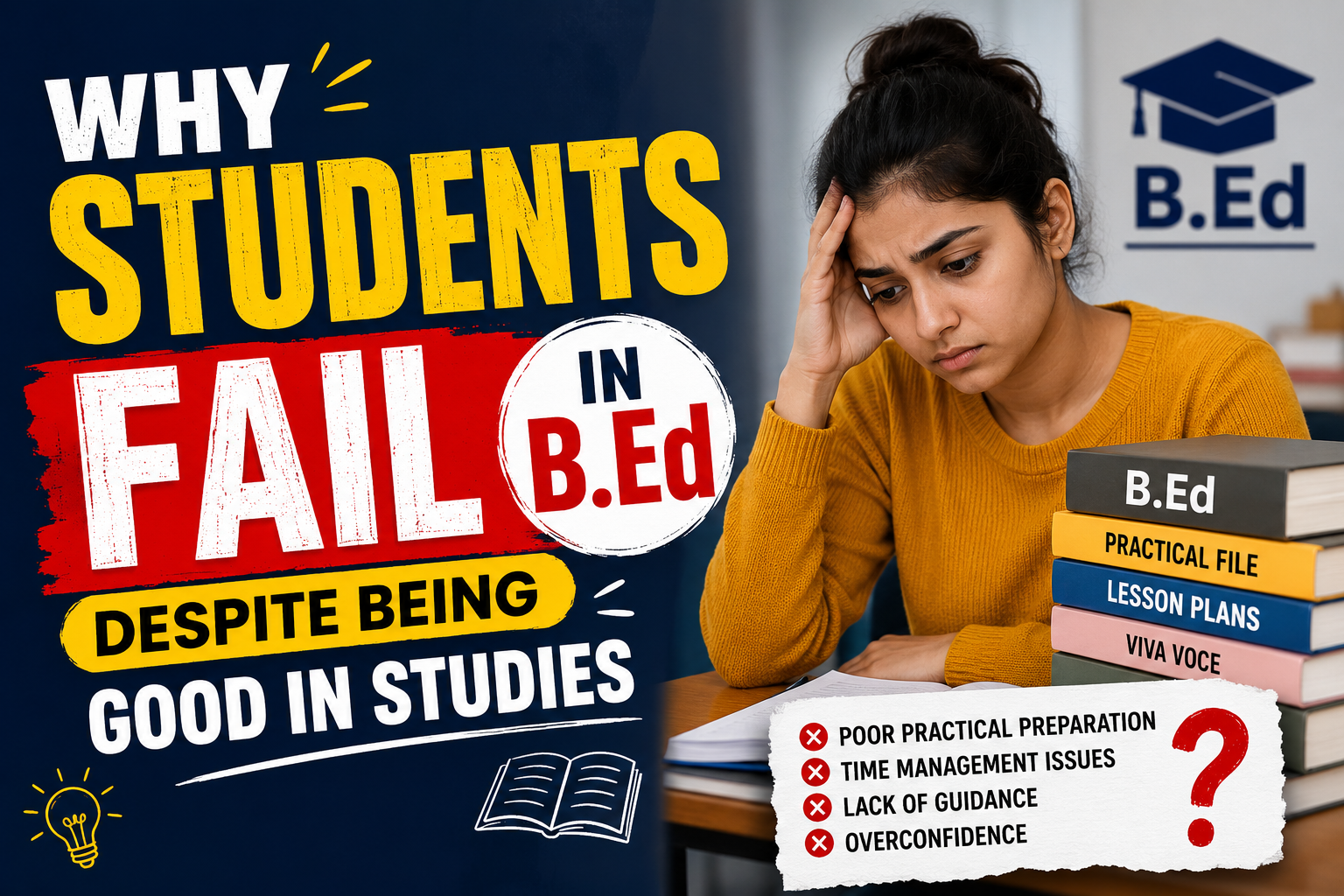
Why do top-scoring university graduates often struggle—and even fail—in B.Ed programs? Discover the hidden traps of teacher education, from the shock of school internships to the paperwork avalanche, and why "book smarts" simply aren't enough to survive a teaching degree.
Imagine a student who topped their university in Chemistry, failing a practical paper in a teaching degree. It sounds impossible, right? After all, if you know the subject inside out, shouldn’t teaching it be a breeze?
Every year, hundreds of academically brilliant students walk into a Bachelor of Education (B.Ed) program expecting an easy ride. They have the "book smarts," the perfect GPA, and a history of acing written exams. Yet, when the results come out, many find themselves struggling, getting penalized, or even failing key components.
If you are a high-achieving student planning to pursue a B.Ed, or a teacher-educator wondering why bright minds stumble, here is the unfiltered truth about why traditional academic success doesn't guarantee a smooth sail in a B.Ed program.
The biggest mistake good students make is harboring a dangerous misconception: "I know my subject perfectly, so I will automatically be a great teacher."
There is a massive gulf between knowing a subject and knowing how to teach it. A traditional degree tests your content knowledge; a B.Ed tests your grasp of pedagogy, educational psychology, and instructional design.
You might be an absolute genius at calculus, but that academic brilliance won't help you when you are tasked with explaining basic fractions to a room full of distracted 10-year-olds. B.Ed demands that you break complex concepts down into digestible, age-appropriate pieces—a skill that academic toppers rarely have to practice for themselves.
For years, the standard academic routine has served good students well: sit in a lecture, take flawless notes, study in isolation, and ace the final written exam. Many have mastered the art of rote learning or conceptual memorization.
But a B.Ed program introduces a massive structural shift.
You are required to study dense psychological development theories by theorists like Jean Piaget, Lev Vygotsky, or B.F. Skinner. However, unlike a standard degree, you can't just memorize their stages of development to get an A+. You are expected to translate those theories into real-time classroom management. When a classroom of thirty teenagers refuses to listen, you cannot "memorize" your way out of the chaos. Brilliant students often panic when fixed textbook answers fail them in dynamic, real-world scenarios.
In a standard degree, practicals are often confined to a lab or a project report. In a B.Ed, a massive chunk of your final grade hinges on peer teaching, viva-voce examinations, and the intensive, high-stakes School Internship.
This is where many introverted or academically isolated students face a rude awakening.
Stage fright, a lack of soft skills, and poor voice modulation can cause even the most intelligent student to crumble during live teaching inspections. If an external examiner walks in and finds your lesson plan unengaging, or notices you are speaking to the blackboard instead of the students, your grades will plummet. Your flawless written notes won't save your score if your classroom presence is lacking.
B.Ed is notorious for an avalanche of relentless paperwork. It is not a degree where you can coast through the semester and cram the night before the final exam. The daily workload is grueling and includes:
Meticulously detailed lesson plans
Reflective diaries and observation logs
Case studies on individual learners
Psychological test reports
Creating physical Teaching-Learning Materials (TLMs)
Good students are often used to managing their time around exam schedules, not continuous daily administrative tasks. When faced with this endless stream of documentation, procrastination sets in. Missing strict deadlines or submitting poorly thought-out lesson plans results in heavy penalization.
Let's address the elephant in the room: many bright students treat a B.Ed as a "side piece" or a fallback option. Because it is a professional training course rather than a hard science or technical degree, a sense of academic arrogance can creep in.
Students skip classes, ignore the nuances of micro-teaching sessions, and assume they can easily "wing it" based on their past academic laurels. By the time they realize that the marking scheme is incredibly rigid and attendance-sensitive, the damage to their academic record is already done.
In STEM or commerce subjects, answers are generally black and white—a formula is either right or a balance sheet matches. B.Ed evaluations, however, are highly subjective. There is rarely "one right answer."
When university examiners grade B.Ed papers, they aren't looking for a standard, dry academic essay. They are scanning your answers for specific pedagogical keywords, structured lesson formats, and an understanding of inclusive classrooms. Students who write beautifully prose-heavy answers but fail to demonstrate a teacher's perspective find themselves losing marks without understanding why.
A B.Ed is not a degree to be passively passed; it is a craft that must be actively practiced.
If you are an academically strong student entering the world of teacher education, the best thing you can do is leave your academic ego at the door. Recognize that teaching is an entirely new skill set that requires empathy, patience, public speaking, organization, and immense resilience.
Book smarts will give you the foundation, but humility, adaptability, and a willingness to learn from your own students are what will ultimately earn you your degree—and make you a fantastic educator.
