

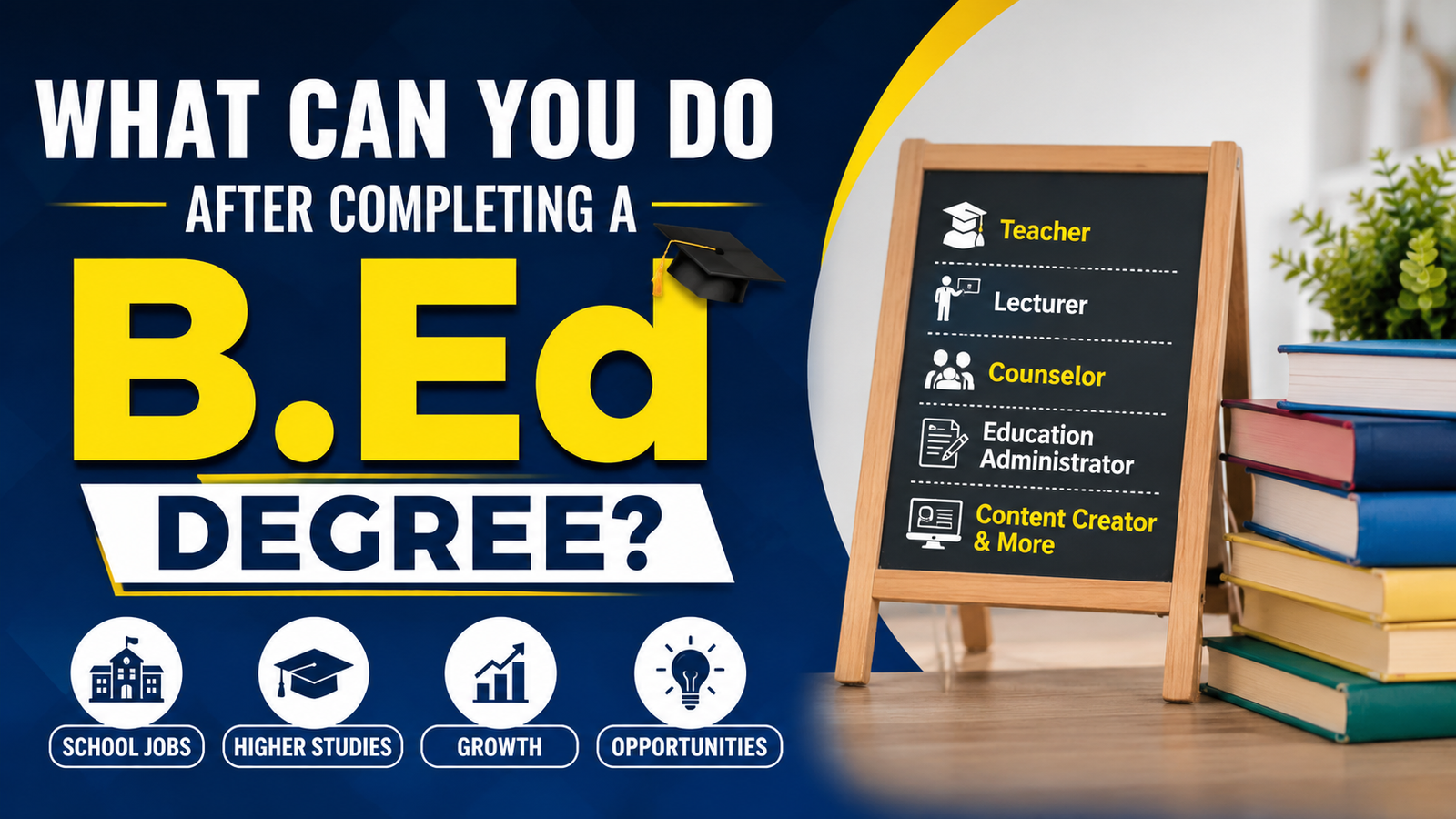
A Bachelor of Education (B.Ed) is more than just a qualification for becoming a teacher—it opens the door to a wide range of rewarding career opportunities. From teaching in government and private schools to exploring roles in EdTech, educational counseling, content development, corporate training, and higher education, B.Ed graduates have numerous paths to build a successful career. This guide explores the best career options after completing a B.Ed, government job opportunities, higher studies, salary prospects, and essential skills to help you choose the right path for your future.
Completing a Bachelor of Education (B.Ed) degree is a significant milestone for aspiring educators. While many students associate a B.Ed solely with becoming a school teacher, the reality is that this professional qualification opens the door to a wide range of career opportunities in education, administration, counseling, corporate training, and the rapidly growing EdTech sector.
With the increasing emphasis on quality education, digital learning, and innovative teaching methods, qualified educators are in high demand across schools, colleges, coaching institutes, educational organizations, and online learning platforms. A B.Ed equips graduates with the knowledge, teaching strategies, classroom management techniques, and communication skills required to shape the future of learners.
Whether your goal is to secure a government teaching job, pursue higher education, work in educational technology, or start your own online teaching venture, a B.Ed provides a strong foundation for a rewarding career.
In this guide, we'll explore the best career options after B.Ed, higher education opportunities, government jobs, salary expectations, and practical tips to help you build a successful career in education.
A Bachelor of Education (B.Ed) is a professional undergraduate degree designed to prepare individuals for teaching careers in schools. It focuses on developing teaching skills, educational theories, classroom management, and student assessment techniques.
The National Council for Teacher Education (NCTE) regulates B.Ed programs in India, ensuring that graduates are equipped to meet modern educational standards.
To pursue a B.Ed, candidates typically need:
A B.Ed program helps students develop valuable professional skills, including:
These skills prepare graduates for diverse roles within and beyond traditional classrooms.
One of the biggest advantages of earning a B.Ed degree is the variety of career paths available. Here are some of the most popular options.
Teaching in schools remains the most common career choice for B.Ed graduates.
Depending on your educational qualifications, you can work as:
Primary teachers educate students from Classes I to V and focus on building strong foundational learning.
TGTs teach middle and secondary school students in specific subjects such as Mathematics, Science, English, Social Science, or Hindi.
Candidates with a postgraduate degree along with a B.Ed can teach senior secondary students (Classes XI and XII).
Government schools generally offer:
Private schools may provide:
Special education teachers work with students who have learning disabilities, developmental challenges, or physical disabilities.
Responsibilities include:
Additional certification in Special Education may be required for certain positions.
Early childhood education is becoming increasingly important.
B.Ed graduates can work in:
These professionals help children develop language, cognitive, emotional, and social skills during their formative years.
Digital education has created numerous opportunities for qualified teachers.
You can:
Online teaching provides flexibility while allowing educators to reach students across the country and even internationally.
Educational counselors guide students in making informed academic and career decisions.
Their responsibilities include:
Schools, colleges, coaching institutes, and educational consultancies frequently hire counselors.
Academic coordinators ensure that educational programs are delivered effectively.
Responsibilities include:
This role is ideal for experienced educators interested in leadership positions.
Education administrators oversee the daily operations of educational institutions.
Career progression may include:
These positions involve school management, policy implementation, budgeting, staff supervision, and academic planning.
Educational content developers create learning materials for students and teachers.
Work opportunities include:
Typical responsibilities include:
Many companies hire educators to train employees.
Corporate trainers conduct sessions on:
Teaching experience and presentation skills make B.Ed graduates suitable for these roles.
Many educators choose independent teaching.
Popular options include:
Experienced tutors often earn competitive incomes while enjoying flexible working hours.
Government teaching positions remain one of the most sought-after career options because of their attractive salary, stability, and career growth.
Some major recruitment opportunities include:
CTET qualifies candidates for teaching positions in central government schools such as Kendriya Vidyalayas and other institutions accepting CTET scores.
Every state conducts Teacher Eligibility Tests (TET) for recruitment into state government schools.
Examples include:
KVS recruits:
These positions offer competitive salaries, accommodation benefits (where applicable), and career advancement opportunities.
NVS schools recruit qualified teachers for residential schools across India, providing excellent salary packages and professional development.
The Delhi Subordinate Services Selection Board recruits teachers for government schools in Delhi.
Army Public Schools recruit teachers through the Army Welfare Education Society (AWES), offering opportunities to work in well-established educational institutions.
State Public Service Commissions and School Education Departments regularly conduct recruitment drives for government teaching positions.
Continuing education can significantly enhance your career prospects.
An M.Ed focuses on advanced educational research, curriculum development, teacher education, and educational leadership.
This program explores educational philosophy, sociology, psychology, and policy in greater depth.
Graduates can pursue careers in research, policy-making, and educational administration.
Candidates interested in research and academia can pursue a doctoral degree.
Career options include:
Specialized certifications help educators stay competitive.
Popular options include:
Educational technology has transformed how learning is delivered.
B.Ed graduates are increasingly recruited by EdTech companies for roles such as:
Design engaging online learning experiences using instructional design principles.
Create learner-centered digital education programs.
Develop accurate subject-specific content for online courses and assessments.
Design school and competitive exam curricula aligned with educational standards.
Deliver live online classes to students through virtual learning platforms.
Create question papers, quizzes, assignments, and evaluation systems.
Many educators build successful independent careers through freelancing.
Popular options include:
Write informative articles about teaching methods, education policies, study tips, and career guidance.
Create educational videos for school subjects, competitive exams, or teacher training.
Develop and sell courses through online learning platforms.
Provide guidance to schools, parents, and educational institutions.
Conduct workshops on classroom management, technology integration, and modern teaching practices.
Developing additional skills can greatly enhance employability.
Important skills include:
Continuous learning helps educators stay relevant in an evolving education landscape.
Salary depends on factors such as experience, location, employer, qualifications, and specialization.
Fresh graduates typically earn between ₹2.5 lakh and ₹5 lakh per annum, with experienced teachers earning significantly more.
Government teachers generally receive salaries as per the applicable pay commission, along with allowances such as Dearness Allowance (DA), House Rent Allowance (HRA), and other benefits. Depending on the role and state or central government employer, annual earnings often range from ₹5 lakh to ₹9 lakh or more.
Income varies based on student numbers, subject demand, teaching platform, and experience. Established online educators can earn substantially through classes, subscriptions, and course sales.
Corporate trainers often earn competitive salaries, with experienced professionals commanding higher compensation based on expertise and industry.
Several factors influence earnings, including:
Choosing the right career depends on your interests and long-term goals.
Consider:
These roles allow you to work directly with students and make a meaningful impact on their learning journey.
Explore roles such as:
These positions focus on leadership, planning, and improving educational outcomes.
You may enjoy careers like:
These roles combine subject expertise with creativity.
The EdTech sector offers exciting opportunities as:
These careers blend education with digital innovation.
Independent career options include:
These roles provide greater control over your schedule and earning potential.
Starting your teaching career requires preparation and continuous learning.
Here are some practical tips:
A Bachelor of Education (B.Ed) is much more than a teaching qualification—it is a gateway to a wide range of rewarding careers in education and beyond. Whether you aspire to teach in a government or private school, pursue higher studies, work in educational leadership, contribute to the EdTech industry, or build a successful freelance career, the opportunities are diverse and continually expanding.
The education sector is evolving rapidly with advancements in technology, changing learning methodologies, and increasing demand for skilled educators. By combining your B.Ed qualification with continuous learning, digital skills, professional certifications, and practical experience, you can create a fulfilling and future-ready career.
Ultimately, the best path after completing a B.Ed depends on your interests, strengths, and long-term aspirations. Choose a direction that aligns with your passion, invest in lifelong learning, and you'll be well-positioned to make a meaningful impact on learners and the education system as a whole.
