

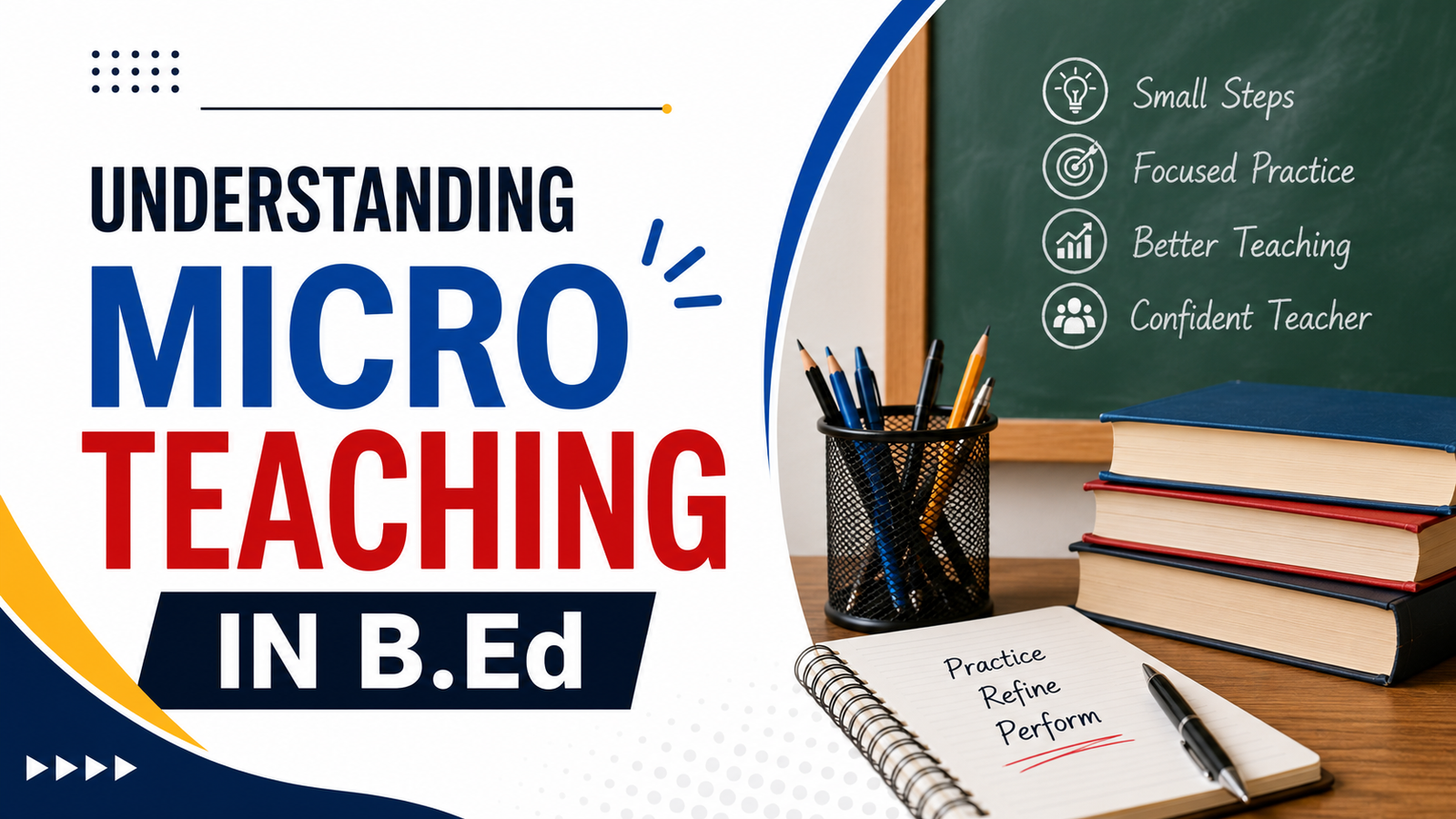
Micro teaching is a powerful training technique in B.Ed that helps future teachers develop essential classroom skills through short, focused teaching sessions. By combining practice, observation, feedback, and re-teaching, it bridges the gap between educational theory and real classroom teaching, making teacher preparation more effective and confidence-building.
Micro teaching is one of the most important components of B.Ed (Bachelor of Education) programmes. It gives future teachers an opportunity to practise teaching in a controlled environment before entering a real classroom. Many student teachers initially find it difficult to apply educational theories during actual teaching. Micro teaching helps overcome this challenge by focusing on specific teaching skills, providing immediate feedback, and encouraging continuous improvement.
In this article, we will explore the meaning, objectives, cycle, skills, advantages, limitations, and practical application of micro teaching in B.Ed.
A B.Ed programme is designed to prepare future teachers for the professional responsibilities of classroom teaching. It includes educational psychology, pedagogy, assessment, classroom management, and teaching practice. However, theoretical knowledge alone is not enough to become an effective teacher.
Micro teaching is a practical training technique that allows student teachers to practise a small part of a lesson with a small group of learners for a short duration. It acts as a bridge between theory and classroom practice. Through repeated practice and feedback, student teachers develop confidence, improve communication, and learn how to handle teaching situations effectively.
Micro teaching is a teacher training technique in which a teacher teaches a small lesson to a small group of students for a short period, usually focusing on one teaching skill at a time.
The concept of micro teaching was developed at Stanford University in the 1960s by Dwight W. Allen and his colleagues. It was introduced to help teachers practise and refine specific teaching behaviours in a simplified teaching environment.
| Traditional Teaching Practice | Micro Teaching |
|---|---|
| Full lesson | Mini lesson |
| Large class | Small group |
| Many skills together | One skill at a time |
| Limited feedback | Immediate feedback |
| Less opportunity for repetition | Re-teaching possible |
Micro teaching simplifies the teaching process so that the trainee can concentrate on improving a particular skill.
The following features make micro teaching unique and effective:
These features create a supportive environment for skill development.
Micro teaching is not merely a classroom activity; it has clear educational objectives.
Repeated practice reduces fear and hesitation.
Trainees learn to speak clearly, ask effective questions, and interact with students.
Each session focuses on one skill, leading to better mastery.
Video recordings and feedback help trainees identify their strengths and weaknesses.
Teachers learn to think about their teaching and make improvements.
The micro teaching cycle is the heart of the process. It follows a systematic sequence.
Plan
Prepare a short lesson focused on one skill
Teach
Deliver the lesson to a small group
Observe
Peers and supervisors observe the teaching
Feedback
Receive immediate constructive comments
Re-plan
Modify the lesson based on feedback
Re-teach
Teach the improved version again
Re-feedback
Review improvement and finalise learning
This cycle promotes continuous professional growth.
A good introduction captures students’ attention and connects new learning with previous knowledge.
Key points:
Questioning stimulates thinking and checks understanding.
Open questions: Encourage detailed responses. Closed questions: Require short or specific answers.
Effective questioning includes:
Explanation should be simple, logical, and interesting.
Use:
Reinforcement encourages student participation.
Verbal reinforcement:
Non-verbal reinforcement:
Good board work improves clarity.
Guidelines:
Variation prevents monotony.
Include:
Closure helps students consolidate learning.
Methods:
Micro teaching offers several benefits.
Mistakes become learning opportunities.
Repeated practice reduces anxiety.
Teachers learn better organisation and presentation.
Trainees learn by observing others.
Students share ideas and strategies.
Feedback and re-teaching lead to gradual refinement.
Despite its benefits, micro teaching has some limitations.
The situation may not fully represent a real classroom.
Small groups may not reflect varied learner needs.
Short lessons may oversimplify teaching.
Real teaching requires integration of many skills.
Some trainees feel nervous being observed.
Understanding these limitations helps use micro teaching more effectively.
| Micro Teaching | Regular Teaching |
|---|---|
| 5–10 minutes | Full period |
| One skill | Multiple skills |
| Few students | Whole class |
| Immediate feedback | Delayed feedback |
| Practice-oriented | Performance-oriented |
Both are important; micro teaching prepares the trainee for regular teaching practice.
Follow these practical tips:
A well-prepared micro lesson is usually more effective than a lengthy one.
Many trainees make similar errors.
Awareness of these mistakes can significantly improve performance.
Feedback is the most powerful element of micro teaching.
Feedback should be specific, objective, and supportive.
Watching one’s own teaching video helps identify unnoticed behaviours.
Effective teachers do not take feedback personally; they use it for growth.
Technology has transformed micro teaching.
Lessons can be recorded and reviewed.
Virtual platforms allow remote practice.
Some tools analyse speaking time, questioning patterns, and engagement.
Teachers can observe their voice, gestures, and interaction objectively.
Technology makes micro teaching more flexible and reflective.
Science
Photosynthesis
Questioning
Students will identify the basic requirements for photosynthesis.
Minute 1 – Introduction
Minute 2 – Previous Knowledge
Minute 3 – Explanation
Minute 4 – Questioning
Minute 5 – Closure
This example shows how a focused micro lesson can effectively practise one teaching skill.
Micro teaching is essential because it:
It is not merely a training activity; it is a foundation for lifelong professional development.
Micro teaching is a valuable and scientifically designed technique in B.Ed teacher education. By reducing the complexity of classroom teaching, it allows future teachers to focus on specific skills, receive immediate feedback, and improve through re-teaching. Although it has certain limitations, its advantages in building confidence, communication, reflection, and professional competence make it an indispensable part of teacher training.
Most importantly, micro teaching should not be viewed only as an examination requirement. It is a professional growth tool that helps student teachers become thoughtful, skilled, and confident educators. As education continues to evolve with technology and diverse learner needs, teachers who practise reflective and skill-based teaching through micro teaching will be better prepared to create meaningful learning experiences for their students.
