

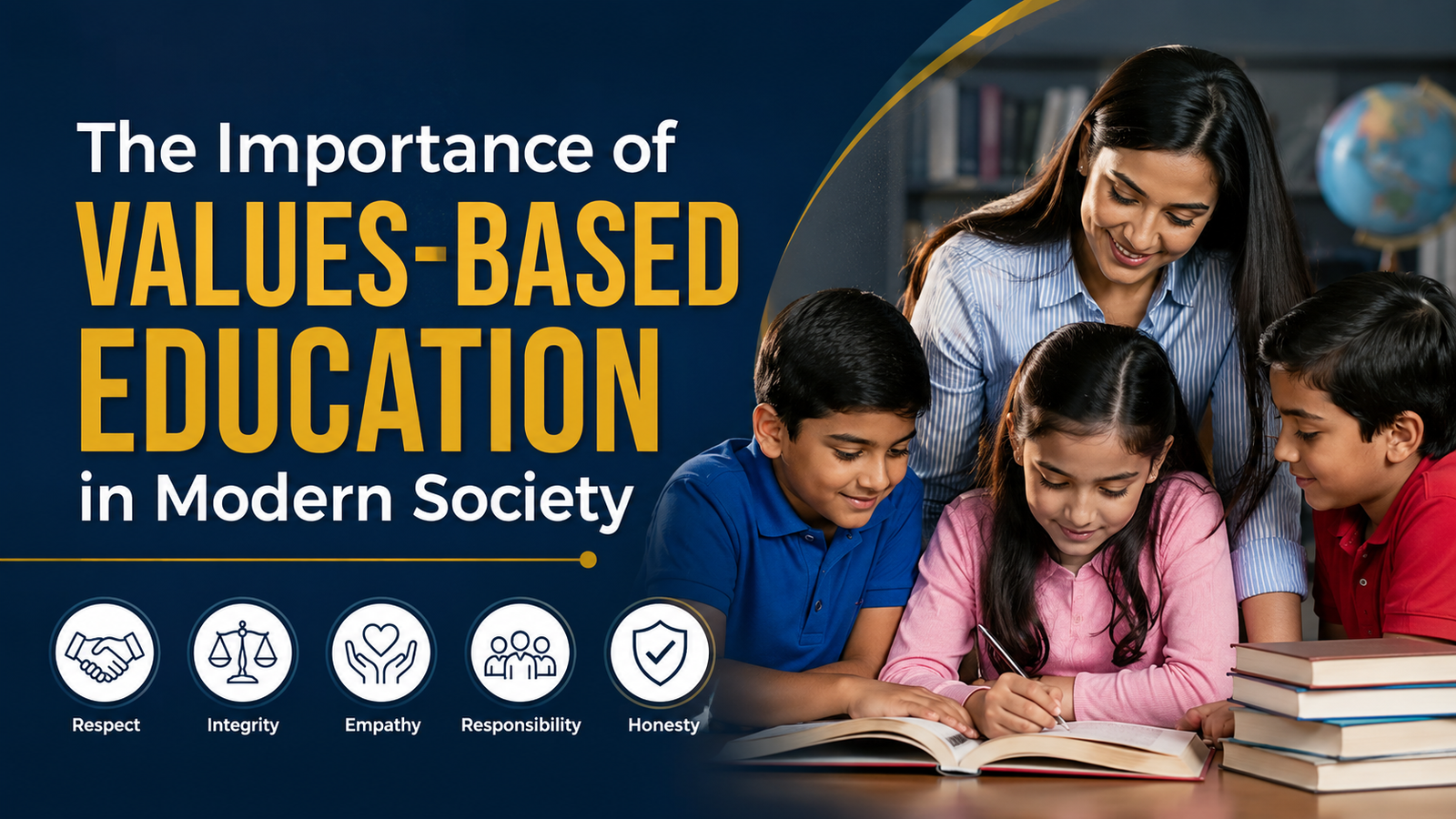
In today’s fast-paced and competitive world, education is often measured by marks and academic success. However, true education goes beyond textbooks and examinations. Values-based education plays a crucial role in shaping responsible, ethical, and emotionally intelligent individuals. It helps students develop essential life skills such as honesty, empathy, discipline, and respect, which are vital for personal growth and social harmony. As modern society faces challenges like digital misinformation, rising stress, and declining moral values, integrating value education into learning has become more important than ever. By combining academic knowledge with strong moral principles, values-based education prepares students not just for successful careers, but for meaningful and responsible lives.
Modern education is often judged by marks, grades, and technical skills. While academic knowledge is important, it is not enough to prepare students for real life. In today’s fast-changing world, students also need strong moral character and ethical understanding.
Values like honesty, kindness, and responsibility help individuals make better life decisions. As society becomes more connected through technology, rapid changes are affecting how people think, behave, and interact. This makes values-based education more important than ever before.
Values-based education is a system of teaching that focuses not only on academic learning but also on developing good human qualities.
It helps students learn:
Difference between academic and values-based education:
Core values include:
Together, these values shape a well-rounded personality.
In the modern world, students face many challenges beyond textbooks.
Some major reasons include:
Without strong values, knowledge alone cannot guide students in the right direction. Values act as a moral compass in difficult situations.
Values play a key role in shaping a student’s personality and mindset.
They help students to:
A student with strong values grows into a confident and balanced individual.
Values-based education also positively impacts learning and discipline in schools.
It leads to:
When students learn respect and responsibility, the classroom environment becomes more productive.
Teachers and schools play a major role in building values.
Teachers act as role models, and students often learn by observing them. A teacher’s behavior, attitude, and communication strongly influence students.
Schools can promote values through:
A strong school environment helps values become a natural part of student life.
The family is the first school of life, and parents are the first teachers.
Parents shape the foundation of values by:
When home and school work together, children develop stronger moral values.
In today’s digital world, students are constantly exposed to online content.
Values-based education helps them to:
Teaching digital responsibility is now a key part of moral education.
Values-based education has long-term benefits beyond school life.
It helps students:
People with strong values are often more respected and trusted in society.
Despite its importance, there are several challenges:
These challenges make it difficult to implement a consistent value-based system.
Schools can take practical steps to strengthen value education:
These methods help students experience values in real situations.
Values-based education is essential for building a strong and responsible society. While academic knowledge builds intelligence, values build character.
True education is a combination of both knowledge and values. Without values, knowledge can be misused, but with values, it becomes powerful and meaningful.
Schools, parents, and educators must work together to ensure that students grow not only as successful professionals but also as good human beings.
