

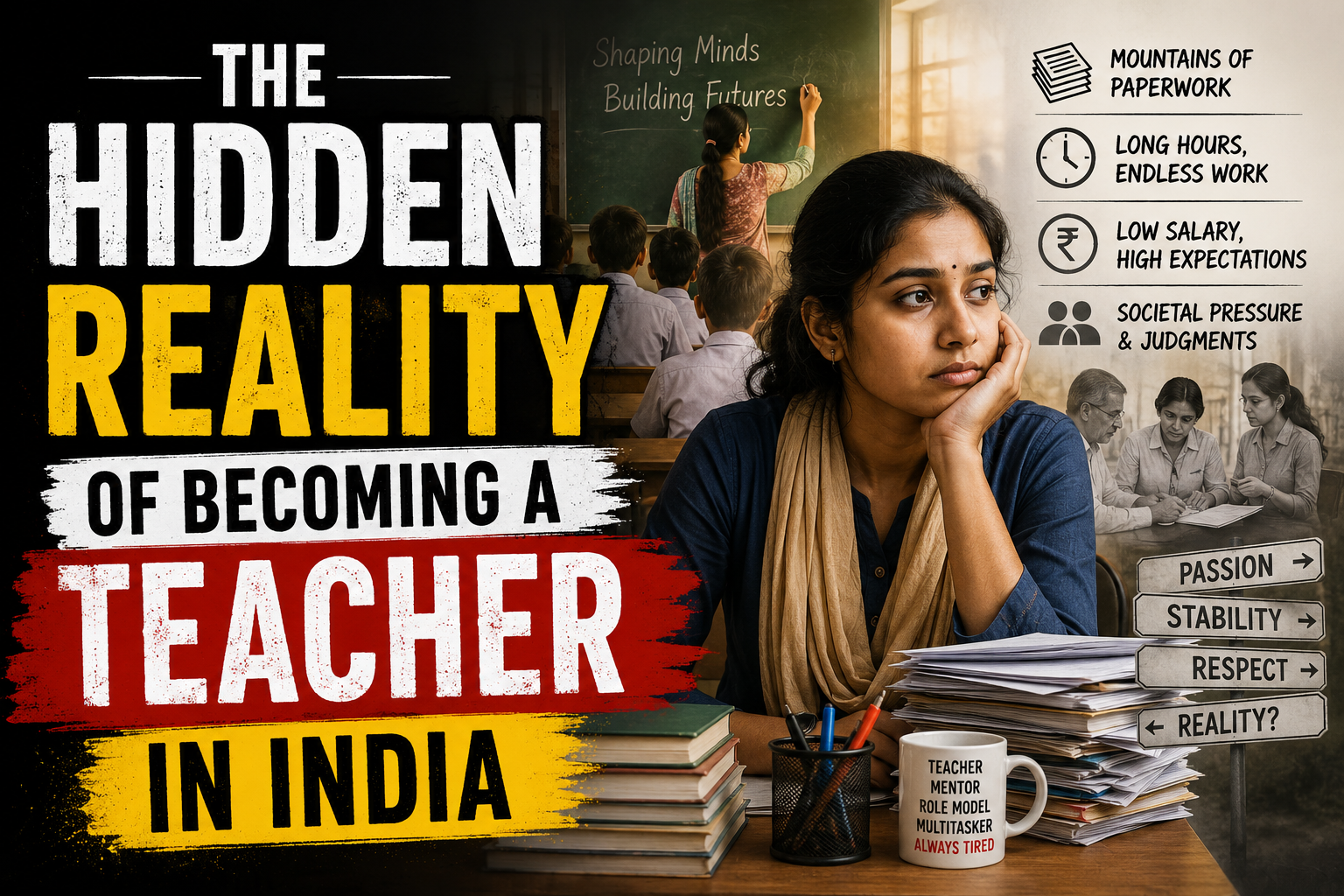
Teaching is often called one of the noblest professions in India, but behind the respect and admiration lies a reality few people truly understand. From competitive exams and low starting salaries to emotional burnout and endless responsibilities beyond the classroom, the journey of becoming a teacher is far more challenging than it appears. This blog explores the hidden struggles, pressures, rewards, and changing realities of teaching in modern India—revealing what life is really like behind the classroom doors.
Teaching in India has always been considered one of the most respected and noble professions. From childhood, many students grow up hearing that teachers are “nation builders” who shape the future of society. Parents encourage stable careers in education, and society often views teachers with admiration and respect.
But behind this image lies a reality that is rarely discussed openly.
The journey of becoming a teacher in India is not always inspiring and rewarding. It is often filled with years of preparation, financial struggles, emotional stress, and professional challenges that many people never see.
As inspiring as teaching may look from the outside, the reality can be emotionally and mentally demanding.
“Behind every classroom smile is a teacher fighting battles no one sees.”
For many young Indians, teaching appears to be a secure and stable career option. Government teaching jobs especially attract students because of job security, fixed salaries, pensions, and social respect.
Family expectations also play a major role. In many households, teaching is considered a “safe” profession, especially for women, because of predictable working hours and social acceptance.
Some students genuinely feel passionate about education and dream of inspiring future generations. They enter the profession with a desire to make a difference in students’ lives.
However, not everyone chooses teaching out of passion. Many graduates enter this field because they could not find opportunities in other industries. For some, teaching becomes a backup career rather than a first choice.
This mix of passion, pressure, and practicality shapes the teaching workforce across India.
Becoming a teacher in India is far more competitive than many people imagine.
Students spend years preparing for exams such as CTET, TET, NET, and state-level recruitment tests. Clearing these exams is only one step. Candidates must also complete degrees like B.Ed or teacher training programs, which require additional time and financial investment.
For middle-class families, these preparation years can become financially stressful. Many aspirants attend coaching institutes while simultaneously dealing with pressure from family and society about their future.
One of the biggest challenges is uncertainty.
Recruitment processes are often delayed, vacancies remain pending for years, and candidates may wait a long time before getting a stable job opportunity. This uncertainty creates frustration and anxiety among aspiring teachers.
The dream of becoming a teacher often demands patience, sacrifice, and emotional resilience.
One of the harshest realities for new teachers in India is low starting pay, especially in private schools.
While government teachers may eventually receive decent salaries and benefits, private school teachers in many cities and rural areas often earn very limited income during the early years of their careers.
Some teachers struggle to manage rent, transportation, and daily expenses despite working full-time. In smaller towns, salaries can be significantly lower compared to the workload expected from teachers.
When compared to professions in technology, management, or corporate sectors, teaching often offers slower financial growth.
This financial gap discourages many talented young graduates from choosing education as a long-term profession.
Many people believe teachers only work during school hours, but the reality is very different.
Teaching responsibilities continue long after classes end.
Teachers spend hours preparing lesson plans, checking assignments, creating exam papers, maintaining records, and completing administrative work. During examination periods, the workload increases even further.
Parent-teacher meetings, student counseling, school events, admissions, and extracurricular activities also become part of a teacher’s routine.
In many schools, teachers are expected to manage multiple responsibilities simultaneously without additional support.
For most educators, teaching is not a “9 to 5” job—it becomes a continuous responsibility.
Teaching is emotionally demanding.
Teachers are expected to manage classrooms, motivate struggling students, maintain discipline, and produce strong academic results—all while staying calm and professional.
Students today face stress, distractions, and emotional challenges, and teachers often become mentors and emotional guides in addition to educators.
School management expectations can create additional pressure. Teachers may feel constantly evaluated based on student performance, parent feedback, and institutional targets.
Over time, this pressure can lead to emotional burnout.
Unfortunately, teachers rarely receive mental health support or appreciation for the emotional labor they perform every day.
Balancing personal life with professional responsibilities becomes another hidden struggle for many educators.
The teaching experience in India varies greatly between government and private institutions.
Government teaching jobs are often associated with better salaries, job security, and long-term benefits. However, competition for these positions is extremely high.
Private schools may offer better infrastructure and modern teaching methods, but teachers frequently face higher workloads and lower salaries, especially in smaller institutions.
Career growth opportunities also differ significantly. While some private schools provide professional development and leadership opportunities, others offer limited growth and unstable working conditions.
Society often places government teachers on a higher status level, which further increases the demand for government teaching jobs.
Teachers in rural India face unique and difficult challenges.
Many schools struggle with poor infrastructure, limited classroom resources, and lack of digital technology. Teachers often work in environments where even basic facilities are unavailable.
In some rural schools, a single teacher may handle multiple classes or subjects at the same time. Managing students from different learning levels becomes extremely difficult.
Social and economic issues also affect students’ education. Poverty, irregular attendance, and lack of parental support create additional obstacles for teachers.
Despite these challenges, many rural teachers continue working with dedication and commitment because they understand the importance of education in transforming communities.
Education in India is rapidly changing because of technology.
Smart classrooms, digital learning platforms, AI-powered tools, and online education have transformed traditional teaching methods.
After the COVID-19 pandemic, online teaching became a major part of education. Teachers had to quickly learn digital tools, virtual classroom management, and online communication methods.
For many educators, adapting to technology was challenging but necessary.
Today’s teachers are expected not only to teach subjects but also to stay updated with evolving educational technology.
The modern teacher must constantly learn, adapt, and upgrade skills to remain effective in the classroom.
Despite the struggles, teaching offers emotional rewards that few professions can match.
Teachers have the power to influence lives, inspire confidence, and shape the future of students. A single encouraging word from a teacher can sometimes change a student’s entire direction in life.
Many educators find deep satisfaction when former students return years later to express gratitude and share their success stories.
The emotional connection between teachers and students creates a sense of purpose that goes beyond salary or job titles.
For passionate educators, this impact becomes the true reward of teaching.
Unfortunately, many talented teachers eventually leave the profession.
Low salaries, mental exhaustion, lack of career growth, and continuous pressure push educators toward other industries. Some move into EdTech companies, corporate training, content creation, or administrative roles where opportunities may offer better financial and professional growth.
Burnout has become increasingly common among teachers who feel overworked and underappreciated.
When society expects teachers to give everything without adequate support, retaining passionate educators becomes difficult.
If India wants stronger education systems, teachers must receive stronger support.
Teacher salaries need improvement, especially in private institutions. Training systems should focus not only on academic knowledge but also on practical classroom skills and emotional well-being.
Administrative burdens should be reduced so teachers can focus more on actual teaching and student development.
Schools and institutions must also provide mental health support and professional growth opportunities for educators.
Most importantly, teachers deserve not just verbal respect but real recognition for their contribution to society.
Teaching is far more complex than most people realize.
It is a profession filled with emotional responsibility, patience, sacrifice, and dedication. Teachers are not just employees completing tasks—they are individuals shaping future generations while managing struggles of their own.
India’s education system cannot grow stronger unless teachers themselves are supported, valued, and empowered.
Because in the end, teaching is not simply about earning a salary.
It is about shaping lives.
“A teacher may not always earn the highest salary, but they shape the people who someday will.”
