

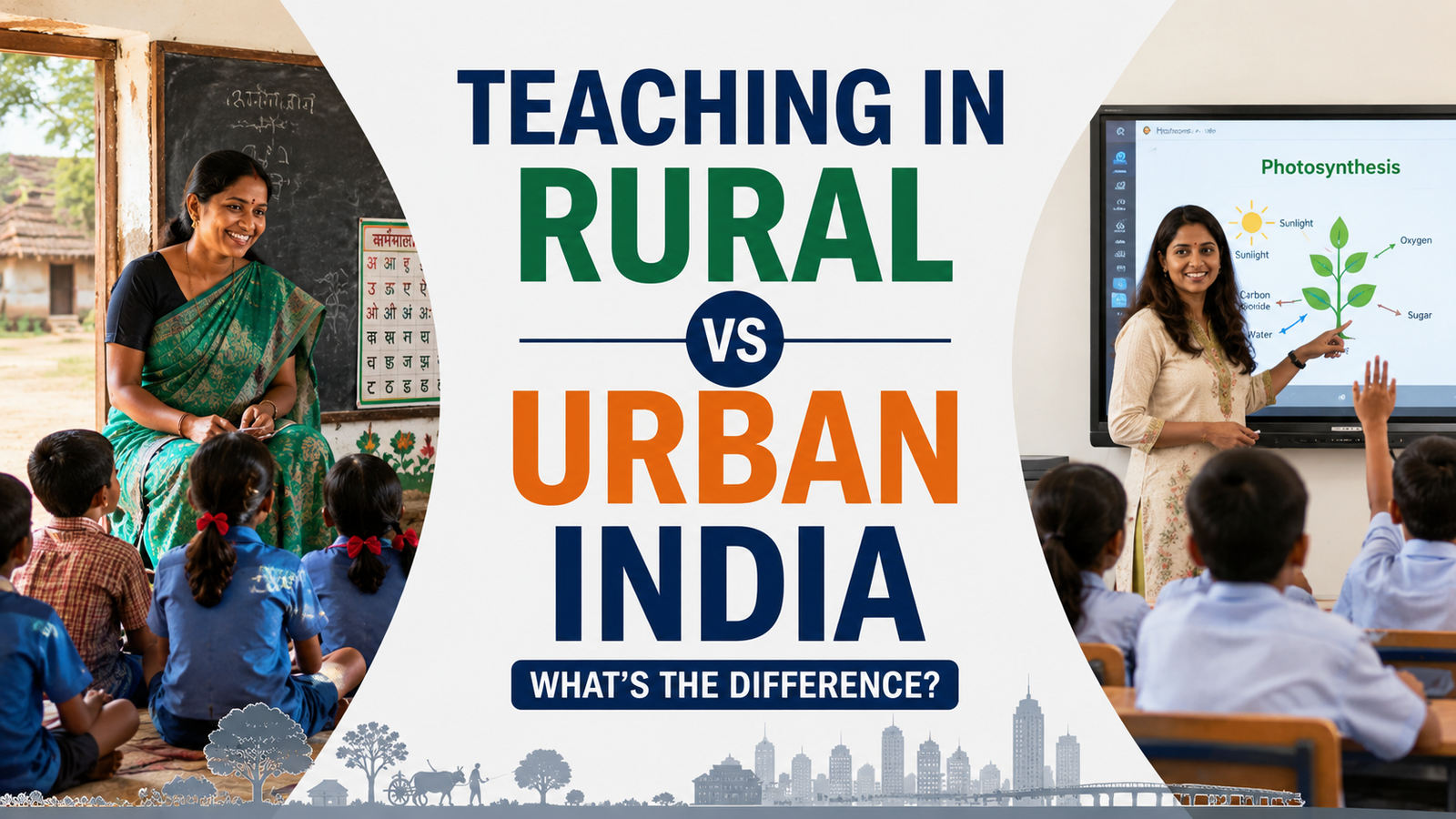
India’s education system is incredibly diverse, with rural and urban schools offering vastly different teaching experiences. From infrastructure and technology to teacher availability and student opportunities, the gap between village classrooms and city schools continues to shape the future of millions of students. This article explores the key differences between teaching in rural and urban India, along with the challenges, strengths, and reforms shaping modern education.
India has one of the largest education systems in the world, serving students from remote villages to highly developed metropolitan cities. While the curriculum may often be the same, the teaching experience in rural and urban India can differ dramatically.
A classroom in rural Bihar and one in Mumbai may follow the same syllabus—but the learning environment, access to resources, and teaching methods can be worlds apart. These differences influence not only academic performance but also students’ confidence, opportunities, and future careers.
Understanding the gap between rural and urban education is important for parents, teachers, students, and policymakers working toward equal learning opportunities for every child.
Rural education mainly refers to schools located in villages and small towns. Most rural schools are government-funded and cater to students from farming or low-income families. These schools often operate with limited infrastructure and fewer teaching resources.
In many villages, schools serve as more than just educational institutions—they become community centers where social and cultural activities also take place.
Urban education includes schools in cities and metropolitan areas where students generally have better access to facilities, trained teachers, and technology. Private schools dominate urban regions, offering modern learning methods, English-medium education, and extracurricular exposure.
City schools are often more competitive, with students preparing early for entrance exams, Olympiads, and career-focused education.
One of the most noticeable differences between rural and urban schools is infrastructure.
Urban schools frequently offer:
Meanwhile, many rural schools still struggle with:
Transportation is another challenge. In several villages, students travel long distances on foot to attend school, which affects attendance and dropout rates.
Urban schools focus heavily on digital learning, while many rural schools are still trying to secure basic educational facilities.
Teacher availability remains a major issue in rural India. Many village schools face staff shortages, forcing a single teacher to manage multiple classes simultaneously.
Common challenges in rural schools include:
Urban schools, on the other hand, usually have better-trained and specialized educators for subjects like science, mathematics, and languages.
The teacher-student ratio is often healthier in city schools, allowing for more personalized attention and improved classroom management.
Teaching methods in rural schools are often traditional and exam-focused. Chalk-and-board instruction remains common, and memorization-based learning is still widely practiced.
Technology integration is limited due to infrastructure challenges and lack of digital resources.
Urban classrooms increasingly use:
Students in urban schools are encouraged to participate in discussions, presentations, and collaborative learning activities, helping them develop communication and analytical skills.
Language plays a major role in shaping educational experiences.
In rural India, regional languages are the primary medium of communication and instruction. While this improves local understanding, it can create challenges when students later encounter English-medium higher education or competitive exams.
Urban schools, especially private institutions, often emphasize English communication from an early age. This can give urban students greater confidence during interviews, presentations, and professional interactions.
The language divide continues to influence career opportunities and higher education access across India.
The COVID-19 pandemic exposed the digital divide between rural and urban India.
Urban students quickly shifted to:
Many rural students, however, struggled due to:
Government initiatives and EdTech platforms are slowly improving digital access in villages, but the gap remains significant.
The digital divide is not just about technology—it is about equal access to quality education.
Urban students usually have access to a wider range of opportunities, including:
Rural students often face barriers such as:
Despite these challenges, many rural students excel academically through determination and community support.
Education is deeply connected to social and economic realities.
In rural areas, poverty often forces students to balance school with family responsibilities or farm work. Child labor and early dropouts remain challenges in some regions.
Urban students face a different kind of pressure. Intense competition, academic expectations, and performance stress can impact mental health and emotional well-being.
Both systems face unique struggles that influence how teaching and learning take place.
The Indian government has introduced several programs to improve educational equality.
Important initiatives include:
Organizations like the Ministry of Education and NCERT continue working toward improving learning outcomes and access to quality education across the country.
Teachers in rural areas often deal with:
Many educators work in challenging environments while trying to maintain learning quality with limited resources.
Urban teachers face:
Managing student stress and maintaining engagement in highly competitive environments are growing concerns in city schools.
Despite the challenges, rural India has produced countless success stories.
Many students from villages have cleared national-level examinations and secured admissions to prestigious institutions through hard work and determination.
Organizations like Teach For India and Pratham have also played a major role in improving educational access and literacy in underserved communities.
Dedicated teachers across rural India continue to prove that quality education is possible even with limited resources.
Urban education certainly offers better infrastructure and exposure, but it also comes with drawbacks such as stress, competition, and commercialization.
Rural education, despite limited resources, often provides:
Quality education depends not only on infrastructure but also on teaching commitment, student motivation, and community involvement.
The future of Indian education lies in reducing the gap between rural and urban learning environments.
Key areas of improvement include:
If implemented effectively, these changes can help create a more balanced and inclusive education system.
Teaching in rural and urban India comes with very different challenges and opportunities. While urban schools may offer better facilities and exposure, rural schools often demonstrate resilience, community support, and determination in the face of limited resources.
Infrastructure alone does not define educational quality. Every child deserves access to skilled teachers, modern learning tools, and equal opportunities—regardless of where they live.
Bridging the rural-urban education gap is not just an educational goal; it is essential for India’s social and economic progress.
