

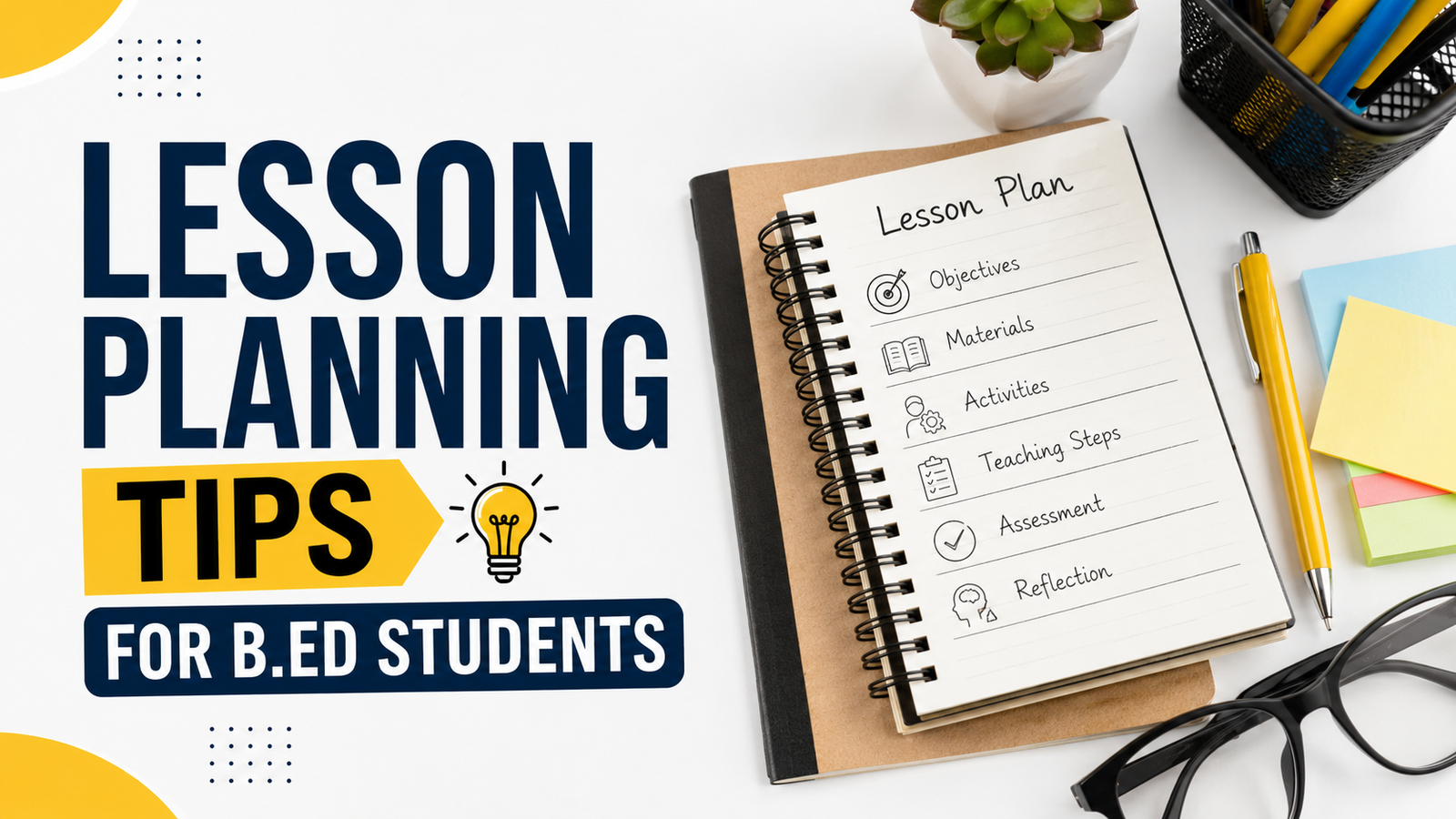
Lesson planning is a vital skill for every B.Ed student, especially during practice teaching, internships, and practical examinations. A well-structured lesson plan acts as a roadmap that helps student teachers organise content, manage time effectively, and engage learners with confidence. It includes clear learning objectives, suitable teaching aids, interactive activities, and proper assessment strategies. By connecting new concepts with students’ prior knowledge and encouraging active participation, lesson planning makes teaching more meaningful and learner-centred. For B.Ed students, developing strong lesson planning habits not only improves classroom performance but also builds the foundation for becoming an effective and reflective teacher.
Lesson planning is one of the most important skills every B.Ed student must develop during teacher training. Whether you are preparing for micro-teaching, practice teaching, school internship, or final practical examinations, a well-structured lesson plan acts as a roadmap for effective teaching.
Many student teachers feel nervous when they enter the classroom for the first time. A properly planned lesson reduces anxiety, improves confidence, and helps the teacher deliver content in a clear and organised manner. It also ensures that learning objectives are achieved within the available time.
In B.Ed programmes, lesson plans are not only academic requirements but also professional tools. During practical exams, classroom observations, and teaching internships, examiners often evaluate how systematically a lesson is planned and executed. Therefore, learning the art of lesson planning is essential for becoming a successful teacher.
A lesson plan is a written outline that describes what a teacher will teach, how it will be taught, which materials will be used, and how students’ learning will be assessed.
| Planning | Teaching |
|---|---|
| Done before the class | Done during the class |
| Focuses on preparation | Focuses on delivery |
| Written and structured | Interactive and dynamic |
| Includes objectives, methods, and evaluation | Includes explanation, questioning, and management |
A good lesson plan does not guarantee perfect teaching, but it greatly increases the chances of effective learning.
When activities, questions, and transitions are planned in advance, the class becomes more organised and disciplined.
Students understand what they are expected to learn, and the teacher remains focused on the desired outcomes.
Planning helps in selecting appropriate charts, models, PPTs, flashcards, worksheets, or digital resources.
B.Ed students often struggle to complete lessons within 35–40 minutes. A lesson plan helps distribute time properly.
After teaching, the lesson plan allows the student teacher to analyse what worked well and what needs improvement.
Learning objectives should be SMART:
“Students will be able to identify three causes of air pollution by the end of the lesson.”
Begin by connecting the new topic with what students already know.
Before teaching Fractions, ask students about sharing a pizza or chocolate equally.
This activates prior knowledge and makes learning meaningful.
Use materials that support understanding:
Avoid using too many aids at once; they should support learning, not distract students.
The first few minutes are crucial for gaining attention.
“Why do we see lightning before we hear thunder?”
Such questions create curiosity.
Present the topic in a logical sequence.
Teaching should not become a one-way lecture.
Recapitulation helps reinforce learning.
Assessment should match the objectives.
Homework should be meaningful and achievable.
Avoid excessive or repetitive homework.
Write 2–4 specific outcomes that students should achieve.
Consider age, ability level, language background, and interests.
Avoid long and complicated sentences in both the lesson plan and classroom explanation.
Include at least one interactive activity.
Use visuals, models, or digital resources that directly support the topic.
Allocate time to each stage and keep a watch or timer.
Write important questions in the lesson plan.
Relating content to daily life increases interest and retention.
If technology fails or students finish early, have a short alternative task.
Ask yourself:
| Activity | Time |
|---|---|
| Introduction | 5 min |
| Presentation | 20 min |
| Interaction / Activity | 8 min |
| Recapitulation | 4 min |
| Evaluation & Homework | 3 min |
This distribution can be adjusted according to the subject and class level.
Avoid: “Students will understand the chapter.”
Write: “Students will list four features of democracy.”
Do not try to teach an entire chapter in one period.
Plan for different learning speeds and abilities.
Too many visuals or animations can confuse students.
Without evaluation, you cannot know whether learning occurred.
Spending 15 minutes on introduction leaves insufficient time for practice and assessment.
Presentation matters in B.Ed practical records.
A well-presented file creates a positive impression on supervisors and examiners.
Modern teachers can save time using digital tools.
Google Docs
Collaborative writing, formatting, and cloud storage
Canva
Design lesson plans, worksheets, posters, and visual aids
PowerPoint
Create classroom presentations and visual explanations
ChatGPT
Generate ideas, activities, questions, and examples
NCERT & DIKSHA
Access curriculum-aligned resources, e-content, and teaching materials
Use these tools ethically and always adapt materials to your learners’ needs.
Subject
Class
Topic
Date
Duration
Learning Objectives
Previous Knowledge
Teaching-Learning Materials (TLMs)
Introduction / Set Induction
Presentation of Content
Student Activity / Interaction
Recapitulation
Evaluation
Homework / Follow-up Activity
You can customise this template according to your university format.
Lesson planning is not just a compulsory B.Ed task; it is a professional habit that every effective teacher develops over time. The more you practise planning, the more confident and organised you become in the classroom.
A good lesson plan focuses on clarity, interaction, and reflection. It sets clear objectives, engages students through meaningful activities, uses appropriate teaching aids, and includes proper assessment. Equally important, it allows the teacher to reflect on the lesson and continuously improve.
Remember, there is no single perfect lesson plan. Every class is different, and every teacher has a unique style. As a B.Ed student, use the basic structure, but do not hesitate to personalise your lesson plans according to your subject, learners, and teaching context.
With regular practice, thoughtful preparation, and a learner-centred approach, lesson planning will gradually become one of your strongest teaching skills and a solid foundation for a successful career in education.
