

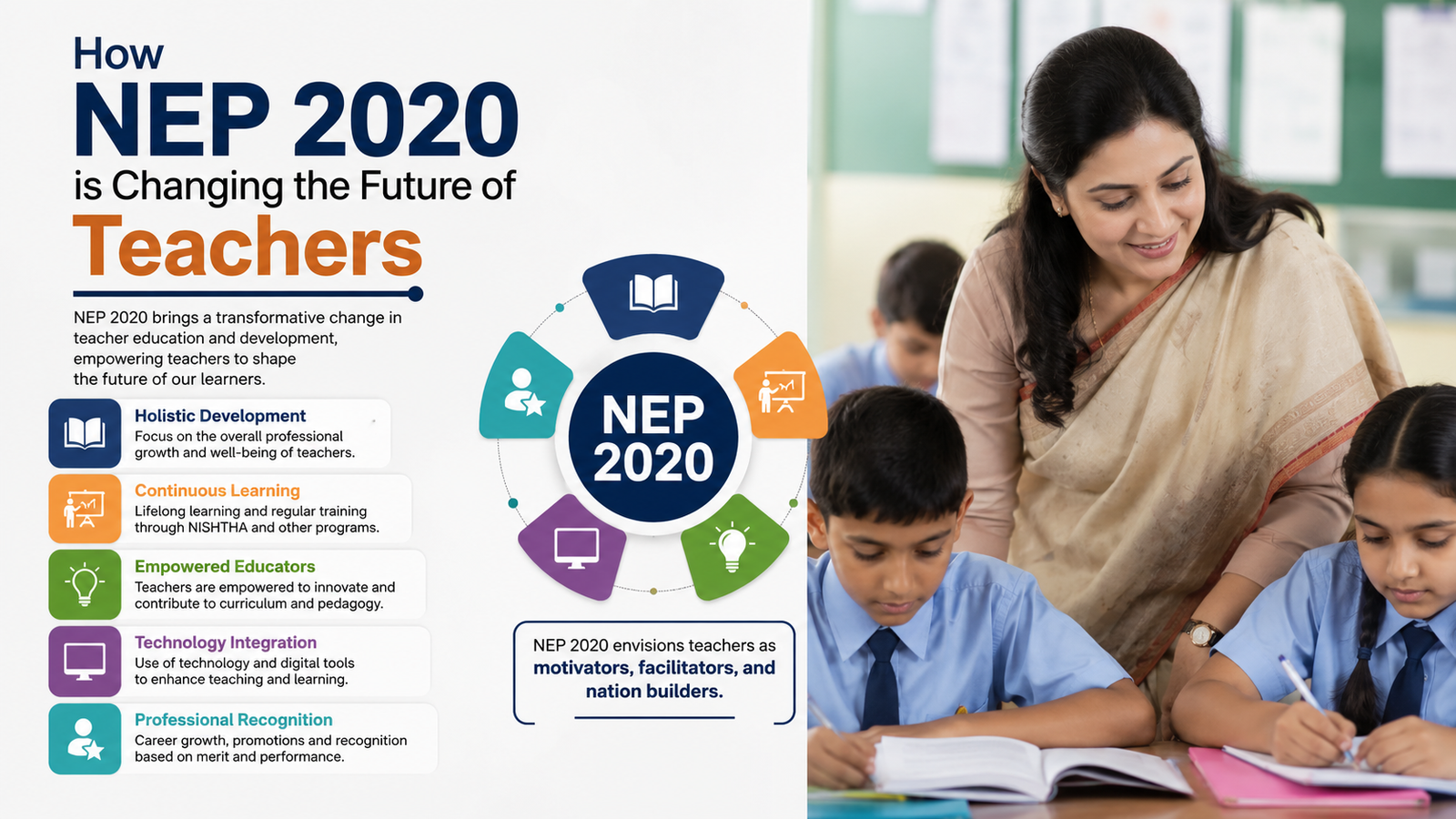
The National Education Policy 2020 is transforming the Indian education system by redefining the role of teachers from traditional instructors to facilitators of learning. This blog explores how NEP 2020 is reshaping teaching methods, integrating technology, promoting skill-based education, and creating new opportunities and challenges for teachers in a rapidly evolving academic landscape.
The introduction of the National Education Policy 2020 marks one of the most significant educational reforms in India’s history. It is designed to reshape not only how students learn but also how teachers teach and grow in their profession.
In today’s rapidly changing world, the role of teachers is no longer limited to delivering textbooks or completing syllabi. Instead, teachers are becoming facilitators of learning, guiding students to think critically, solve problems, and develop real-world skills. NEP 2020 emphasizes this transformation strongly.
Teacher transformation is essential because no educational reform can succeed without empowered, skilled, and future-ready educators.
NEP 2020 is a comprehensive policy framework introduced to transform India’s education system from school to higher education.
Its main objectives include:
Unlike traditional education systems that focused heavily on memorization and exam performance, NEP 2020 focuses on creativity, critical thinking, and practical application of knowledge.
One of the most important changes under NEP 2020 is the transformation of the teacher’s role.
Teachers are now expected to move from being “information providers” to “learning facilitators.” This means:
This shift makes classrooms more interactive and student-cantered.
NEP 2020 places strong emphasis on continuous teacher development. Teaching is no longer a static profession; it requires lifelong learning.
Key aspects include:
This ensures that teachers are always evolving along with educational needs.
Technology plays a central role in NEP 2020.
Teachers are now expected to integrate:
While this opens new opportunities for engaging teaching, it also brings challenges such as adapting to new tools and overcoming digital gaps in infrastructure. However, it ultimately makes teaching more effective, interactive, and accessible.
NEP 2020 encourages a shift from rigid subject boundaries to multidisciplinary learning.
Teachers are now required to:
This approach prepares students for dynamic industries and real-world challenges.
Classroom teaching is becoming more dynamic and interactive under NEP 2020.
Key changes include:
The classroom is evolving into a space where students actively explore, question, and apply knowledge.
NEP 2020 promotes inclusivity and linguistic diversity in education.
Teachers are encouraged to:
This helps create a more accessible and equitable education system.
The policy also enhances the professional status of teachers.
Teachers now have opportunities for:
This makes teaching a more dynamic and rewarding career.
Despite its benefits, NEP 2020 also brings challenges such as:
These challenges require strong support systems and continuous professional development.
To succeed in this evolving system, teachers should:
Adaptability and lifelong learning are key for future-ready educators.
NEP 2020 is not just an educational policy—it is a transformation blueprint for the entire teaching profession. It redefines teachers as facilitators, innovators, and lifelong learners.
As education becomes more skill-based, inclusive, and technology-driven, teachers will play a central role in shaping the future of India’s students and society. Embracing this change will ensure a stronger, more capable, and future-ready education system.
