

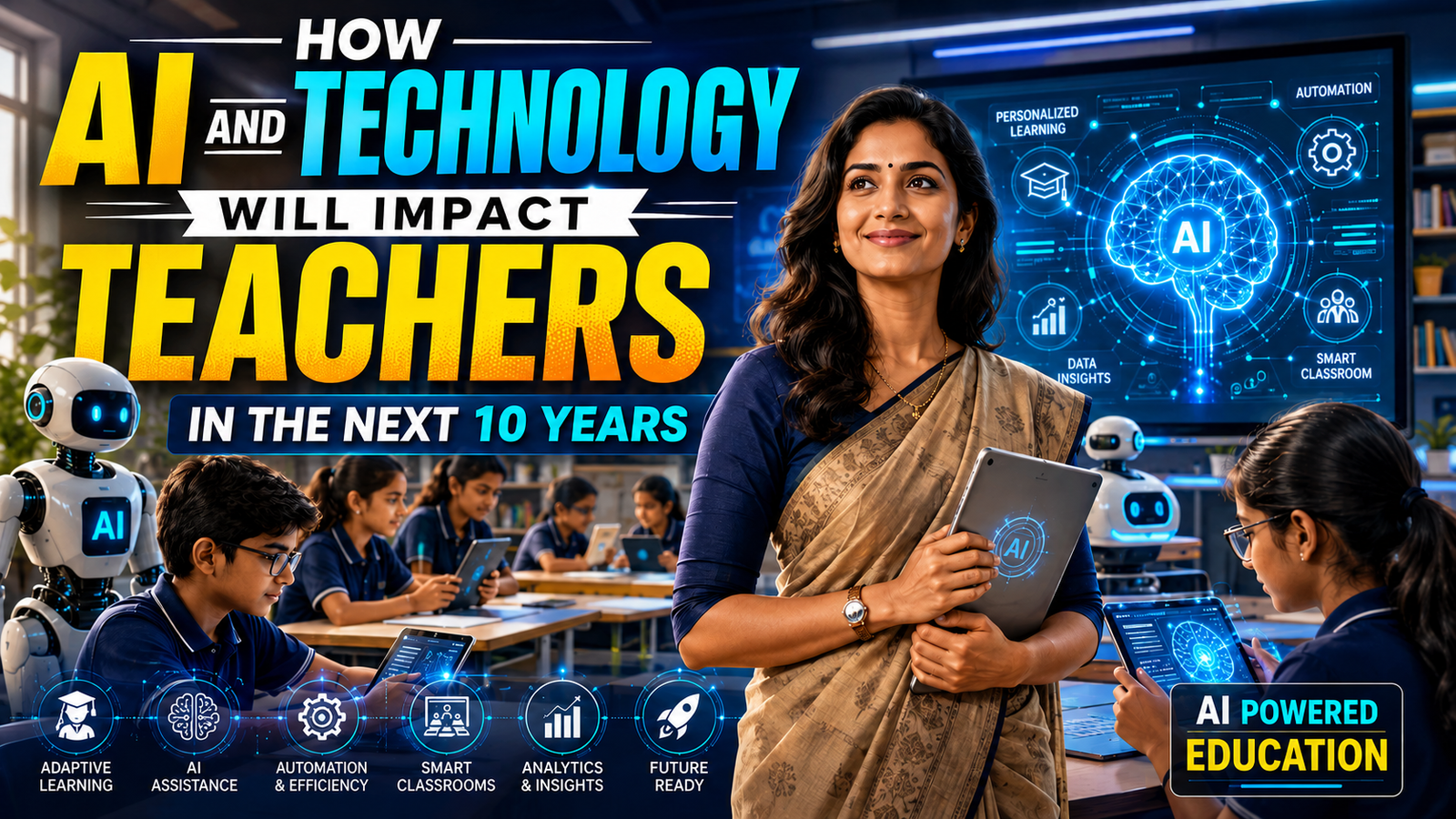
Artificial Intelligence and technology are rapidly transforming the education system, reshaping how teachers teach and how students learn. In the next 10 years, AI will take over repetitive tasks like grading and administration, while also enabling personalized learning experiences for every student. Smart classrooms, digital tools, and AI-powered platforms will make education more interactive and efficient. However, the role of teachers will remain crucial—not as content providers, but as mentors, guides, and emotional supporters. The future of education lies in the powerful collaboration between human teachers and intelligent technology
Education is undergoing one of the biggest transformations in history. Traditional classrooms are rapidly shifting toward AI-powered and technology-driven learning environments. Today’s students are no longer limited to textbooks and blackboards—they are surrounded by digital tools, smart devices, and intelligent learning systems.
In this evolving ecosystem, the role of teachers is also changing. Teachers are no longer just “knowledge providers.” Instead, they are becoming facilitators, mentors, and guides who help students navigate a world full of information.
One of the biggest impacts of AI in education will be the reduction of repetitive and time-consuming tasks.
AI tools can already:
This automation will free teachers from routine tasks, allowing them to focus more on meaningful teaching, student interaction, and creative lesson delivery.
Every student learns differently, and AI makes it possible to address this diversity effectively.
AI systems can:
In this system, teachers will not be replaced—they will evolve into learning coaches who guide each student individually based on data-driven insights.
The classroom of the future will be far more interactive and immersive than today.
We will see:
Learning will become more engaging, visual, and practical rather than purely theoretical.
While AI is powerful in delivering content, it cannot replace human emotions.
Teachers will increasingly focus on:
In a world dominated by technology, the human connection provided by teachers will become even more valuable.
To stay relevant in the next decade, teachers will need to upgrade their skill sets.
Important skills include:
Interestingly, memorization will become less important, while adaptability and creativity will become essential.
Despite its benefits, AI will also bring challenges.
Some major concerns include:
Addressing these challenges will be crucial for a smooth transition into AI-powered education.
It is important to understand that AI is not here to replace teachers.
Instead:
Technology will enhance teaching, not eliminate it.
By 2035, classrooms may look very different from today.
We can expect:
Education will become more connected, flexible, and student-centered.
The future of education will not be about humans versus machines. It will be about collaboration between humans and AI.
The best education system will be one where:
Teachers who adapt to this change will not become obsolete—instead, they will become more powerful, more impactful, and more essential than ever before.
