

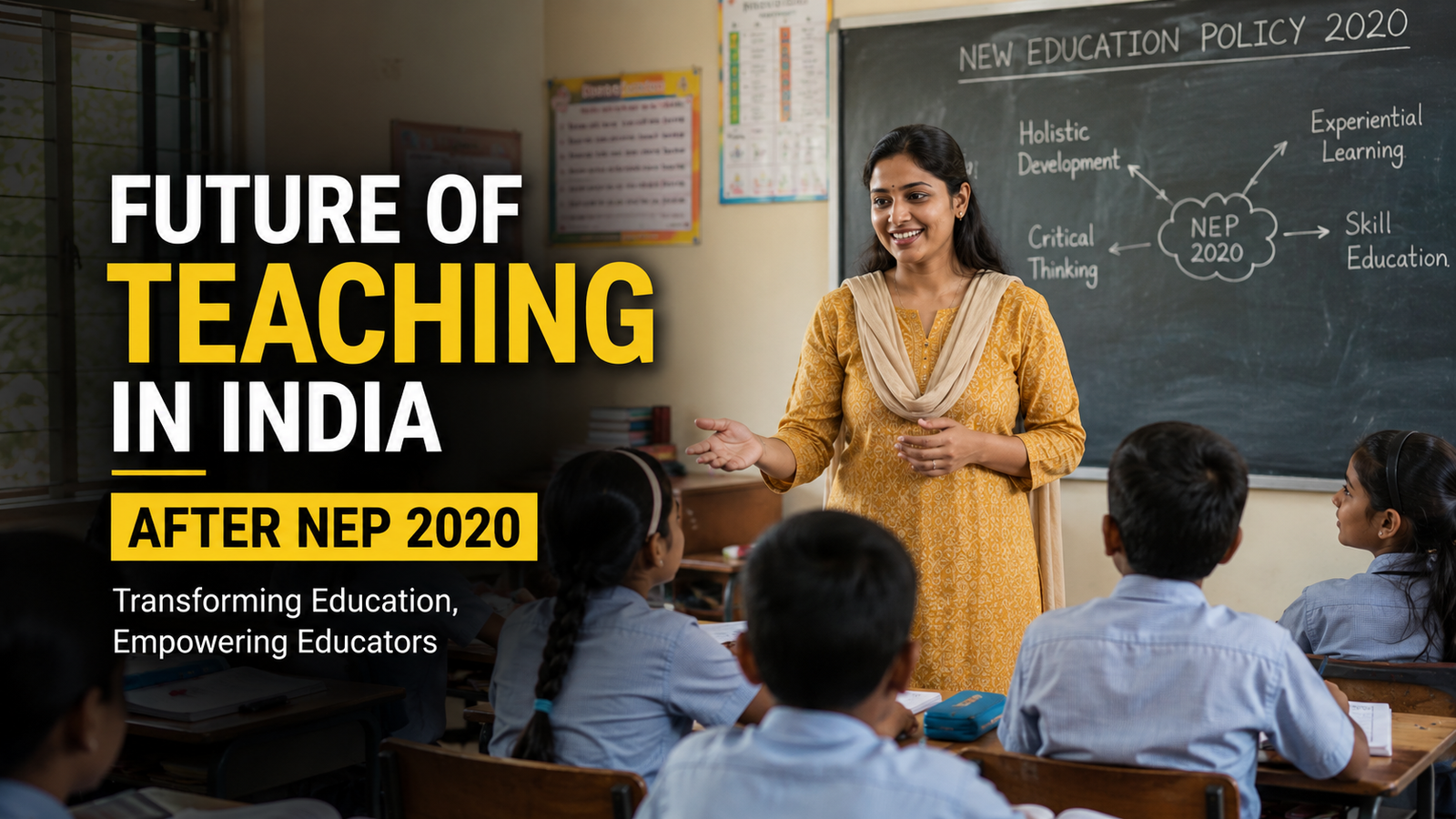
The National Education Policy (NEP) 2020 is transforming the Indian education system and redefining the future of teaching in India. Moving away from rote learning, it focuses on holistic, skill-based, and experiential education that encourages critical thinking and creativity among students. In this new framework, teachers are no longer just information providers but facilitators, mentors, and guides who play a crucial role in shaping students’ overall development. With the integration of digital tools, smart classrooms, and continuous professional training, the teaching profession is becoming more dynamic and future-ready. While challenges like infrastructure gaps and the digital divide still exist, NEP 2020 is paving the way for a more innovative, skilled, and respected teaching ecosystem in India.
The teaching profession has always been one of the most respected careers in India. Teachers play a vital role in shaping the future of students and, ultimately, the nation. However, the education system is rapidly evolving with new technologies, changing skill demands, and global competition.
In this context, the National Education Policy (NEP) 2020 has emerged as a major turning point in Indian education. It is not just a policy change but a complete transformation of how teaching and learning will take place in schools and higher education institutions.
NEP 2020 is reshaping classrooms, redefining the role of teachers, and preparing students for future-ready skills.
The National Education Policy (NEP) 2020 is a government policy introduced to reform the Indian education system.
Its main purpose is to make education:
One of the biggest shifts under NEP 2020 is moving away from rote learning and memorization toward conceptual understanding and practical knowledge. The policy aims to develop critical thinking, creativity, and problem-solving skills among students.
NEP 2020 introduces several important changes in the education structure:
These changes require teachers to adopt new methods of teaching that are more interactive and student-centered.
Under NEP 2020, the role of teachers is undergoing a major transformation.
Teachers are no longer just information providers. Instead, they are becoming:
Modern teachers are expected to encourage creativity, critical thinking, and independent learning among students. They also play a more active role in the overall personality development of learners.
Technology is playing a major role in shaping the future of education.
With NEP 2020, classrooms are becoming more digital and interactive through:
Teachers are also required to upgrade their digital skills to effectively use these modern teaching tools.
NEP 2020 strongly promotes skill-based education.
Key changes include:
This shift means teachers must also develop industry-relevant knowledge and adopt practical teaching methods instead of purely theoretical instruction.
Teacher development is a major focus area under NEP 2020.
Important highlights include:
Teachers are now expected to continuously upgrade their knowledge and teaching skills throughout their careers.
NEP 2020 is also expanding career opportunities for teachers.
New opportunities include:
This shows that teaching is no longer limited to classrooms but has expanded into multiple professional domains.
Despite its benefits, NEP 2020 faces several implementation challenges:
Overcoming these challenges is essential for the successful implementation of the policy.
The future of teaching in India looks promising and dynamic.
Key trends include:
Teachers who continuously upgrade their skills will have better career opportunities in the future.
NEP 2020 is transforming the Indian education system in a significant way. It is making education more practical, flexible, and student-centered.
In this new system, teachers will play a more important and dynamic role than ever before. The future of teaching in India is not just about classrooms—it is about innovation, digital learning, and skill development.
Overall, NEP 2020 is shaping a future where teachers are empowered, students are more skilled, and education becomes truly meaningful.
