
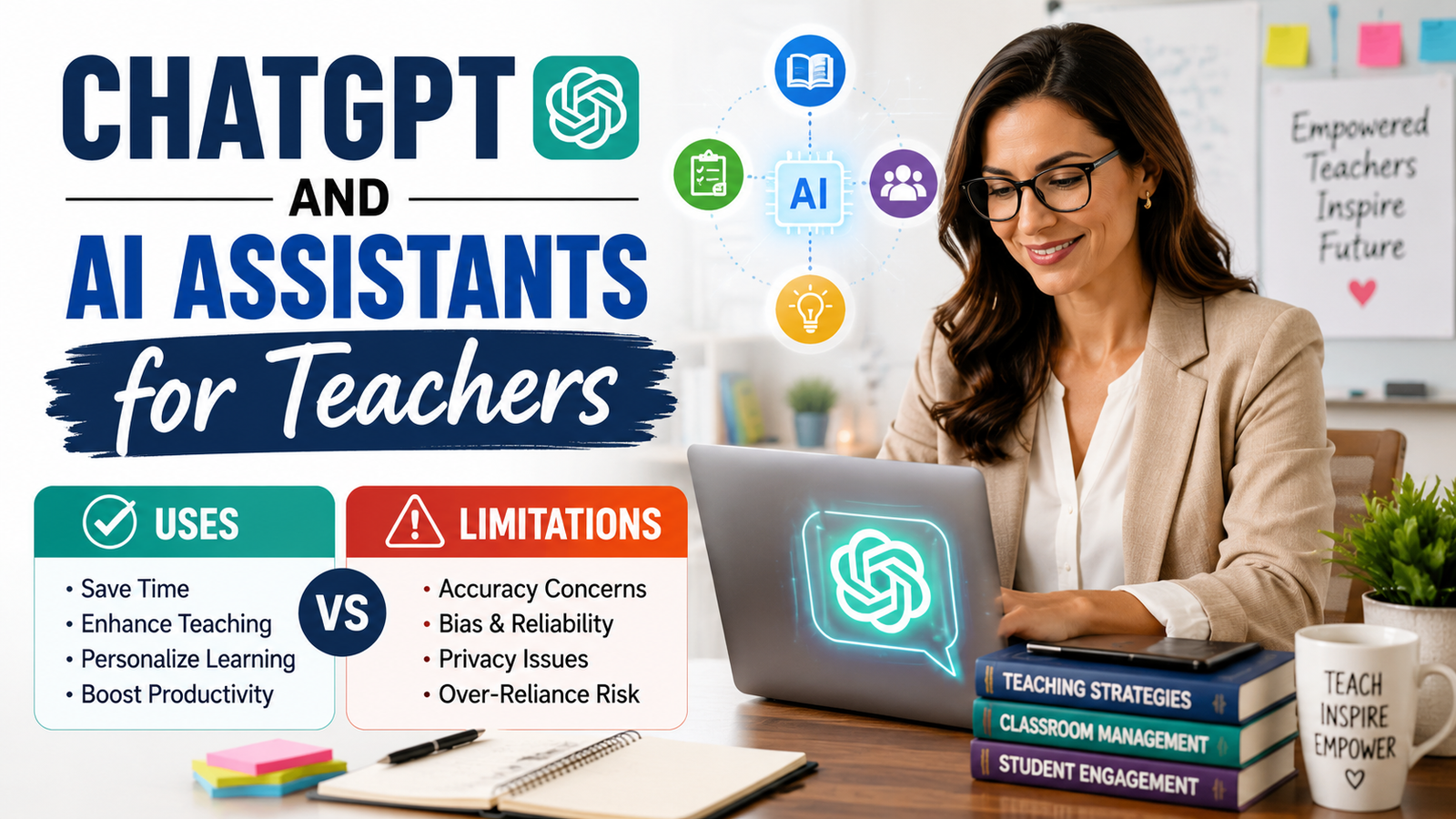
Artificial Intelligence is changing the way teachers approach education by helping them plan lessons, create learning materials, personalize instruction, and manage routine tasks more efficiently. Tools like ChatGPT and AI assistants are becoming valuable classroom partners, offering educators quick access to ideas, resources, and teaching support. However, AI is not a replacement for teachers. While it can improve productivity and encourage innovation, human skills such as empathy, creativity, critical thinking, and emotional understanding remain essential in education. This blog explores the uses, benefits, limitations, and best practices for teachers using AI tools to create more effective and engaging learning experiences.
Artificial Intelligence (AI) is rapidly transforming the education sector by changing the way teachers plan lessons, create learning materials, assess students, and support individual learning needs. From automated grading systems to intelligent tutoring platforms, AI technologies are becoming valuable tools for improving teaching efficiency and enhancing student experiences.
Among the most widely discussed AI tools today is ChatGPT, along with other AI-powered educational assistants. These technologies are gaining attention among educators because they can help reduce repetitive tasks, generate creative teaching ideas, and provide quick access to educational resources. Teachers who once spent hours preparing worksheets, lesson plans, and assessment materials can now use AI tools to support these activities more efficiently.
However, the growing use of AI in classrooms also raises an important question: Can AI support teachers without replacing the essential human role of educators?
The answer lies in understanding AI as a supportive partner rather than a replacement for teachers. While AI can assist with many academic and administrative tasks, teachers remain essential because they provide emotional support, motivation, creativity, and personal connections that technology cannot replicate.
ChatGPT and AI-powered educational assistants are digital tools that use artificial intelligence to understand questions, generate responses, and assist users with various tasks. These tools are designed to analyze large amounts of information and provide human-like responses based on user instructions.
In education, AI assistants can help teachers with a wide range of responsibilities, including preparing lessons, creating classroom activities, explaining difficult concepts, generating assessment questions, and suggesting teaching strategies.
For example, a teacher preparing a science lesson can ask an AI assistant to create an activity suitable for different age groups. Similarly, a language teacher can use AI to develop vocabulary exercises, writing prompts, or reading comprehension questions.
Some common classroom applications of AI include:
When used effectively, AI assistants can become valuable tools that improve productivity and encourage innovation in education.
Lesson planning is one of the most time-consuming responsibilities for teachers. AI assistants can help educators generate ideas, organize content, and design effective learning experiences.
Teachers can use AI tools to:
For example, a teacher teaching mathematics can ask an AI assistant to suggest interactive activities for explaining difficult concepts. This allows teachers to spend more time focusing on student engagement rather than only preparing materials.
AI can also support curriculum development by helping teachers align lessons with educational goals and learning outcomes.
Preparing teaching resources often requires significant time and effort. AI assistants can support teachers by quickly generating educational materials that can be customized according to classroom needs.
Teachers can use AI to create:
For instance, a teacher can request different versions of the same activity for beginner, intermediate, and advanced learners. This flexibility helps teachers create more inclusive learning environments.
However, AI-generated resources should always be reviewed and adjusted by teachers to ensure accuracy and suitability for students.
Every student learns differently. Some students may need additional explanations, while others may require advanced challenges. AI assistants can help teachers create personalized learning materials that address different abilities and learning styles.
Teachers can use AI to:
By helping teachers provide differentiated instruction, AI can contribute to more personalized and student-centered classrooms.
Assessment is an important part of teaching because it helps educators understand student progress. AI assistants can support teachers in designing assessments and providing feedback.
Teachers can use AI tools to:
For example, AI can help generate feedback templates that teachers can personalize for individual students. This can save time while allowing educators to focus on meaningful conversations with learners.
AI assistants can also support teachers in their own professional growth. Educators can use AI tools to explore new teaching methods, learn about educational theories, and develop digital skills.
Teachers can ask AI assistants to:
As education continues to evolve, developing AI literacy will become an important skill for teachers.
AI tools offer several advantages that can improve teaching efficiency and classroom experiences.
Teachers often spend many hours completing administrative and preparation tasks. AI can reduce this workload by assisting with content creation, planning, and organization.
AI can provide new ideas, examples, and activities that teachers may not have considered. This allows educators to explore creative approaches to teaching.
Instead of searching through multiple sources, teachers can use AI assistants to quickly generate ideas and resources for classroom use.
AI can help educators experiment with new methods such as personalized learning, interactive activities, and technology-supported instruction.
AI tools can assist with tasks such as creating reports, organizing information, and preparing routine documentation, allowing teachers to focus more on student interaction.
Although AI offers many benefits, it also comes with important challenges that educators must consider.
AI-generated information is not always correct. AI systems may sometimes provide inaccurate, incomplete, or outdated information.
Teachers must carefully review AI-generated content before sharing it with students. Professional judgment remains necessary to ensure that learning materials are accurate and appropriate.
Teaching is not only about delivering information. It involves understanding students’ emotions, backgrounds, challenges, and learning experiences.
AI cannot fully replace the empathy, encouragement, and personal connection that teachers provide. A teacher can recognize when a student is struggling emotionally or needs additional motivation—something AI cannot completely understand.
While AI can support teachers, excessive dependence on technology may reduce creativity and critical thinking.
Teachers should use AI as an assistant rather than allowing it to make all educational decisions. Human expertise, experience, and professional judgment must remain at the center of teaching.
The use of AI in education raises questions about student data protection and privacy.
Schools and teachers should ensure that:
Responsible AI use is essential for maintaining trust between educators, students, and families.
AI tools have created new challenges related to student assignments and assessments. Students may use AI to complete homework or write assignments without developing their own skills.
To address this issue, schools may need to:
The goal should not only be detecting AI use but helping students learn how to use technology responsibly.
To maximize the benefits of AI while reducing risks, teachers should follow responsible practices:
The most effective approach is a partnership between human expertise and artificial intelligence.
The role of AI in education is likely to continue expanding. Future AI tools may provide more advanced support for personalized learning, automated administrative tasks, and classroom assistance.
However, the future of education will not be about replacing teachers with machines. Instead, it will focus on combining AI capabilities with human teaching skills.
Teachers who develop AI literacy will be better prepared to use these tools effectively. Understanding how AI works, recognizing its limitations, and applying it responsibly will become important skills for modern educators.
The classrooms of the future will likely involve collaboration between teachers and AI systems, where technology handles repetitive tasks while educators focus on creativity, mentorship, and meaningful human interaction.
ChatGPT and AI assistants have the potential to transform education by helping teachers save time, create better learning resources, and support diverse student needs. These tools can make teaching more efficient and open new possibilities for innovation.
However, AI also has limitations. Issues related to accuracy, privacy, overdependence, and academic integrity require careful consideration.
The most effective use of AI in education is not to replace teachers but to empower them. Teachers bring qualities that technology cannot replicate—empathy, inspiration, creativity, and human connection.
When used responsibly, AI can become a valuable teaching partner that supports educators and enhances learning experiences for students.
