

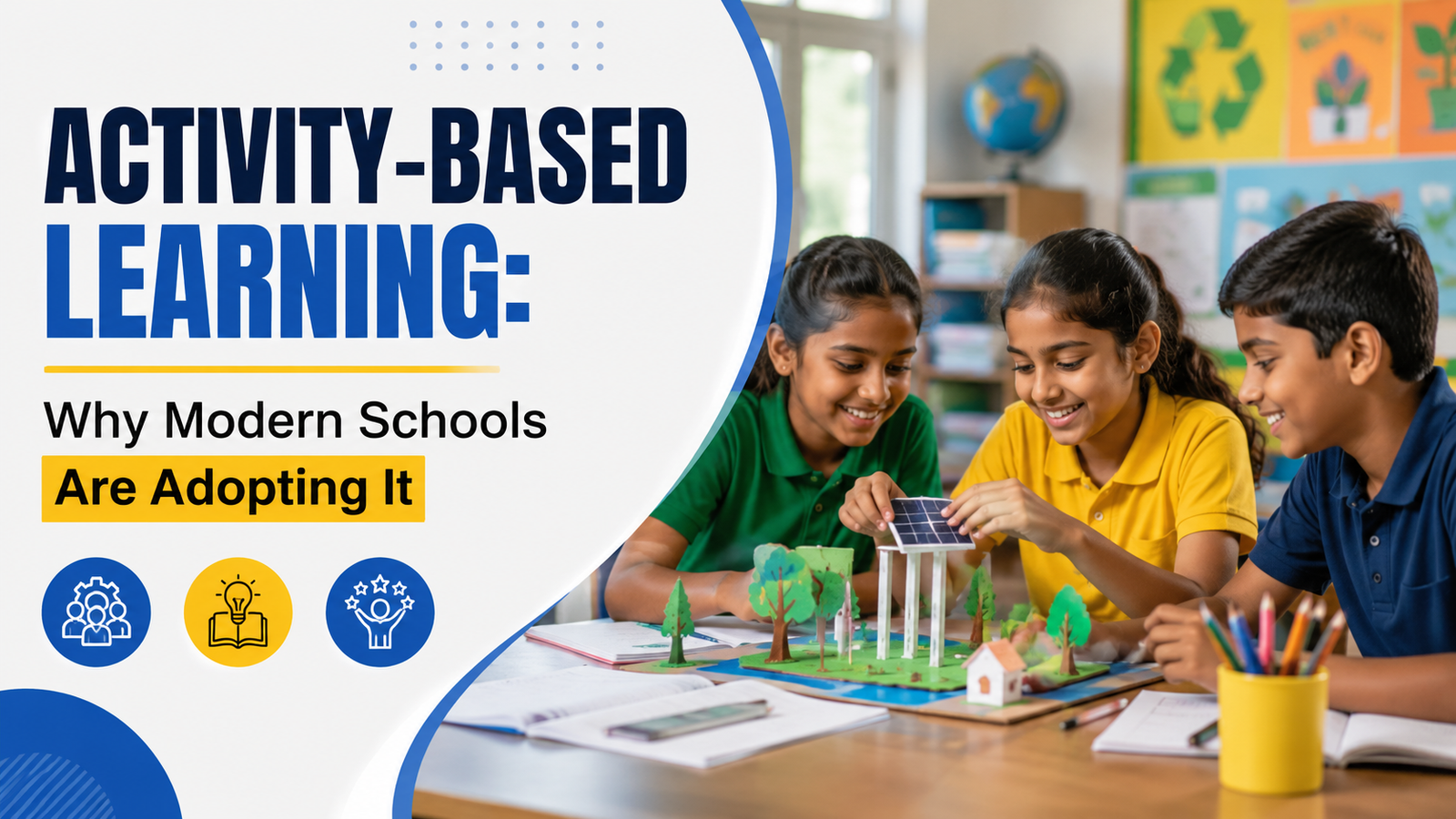
Activity-Based Learning (ABL) is transforming modern education by making classrooms more interactive, engaging, and student-centered. Instead of relying solely on traditional lectures, ABL encourages hands-on experiences, collaboration, and real-world problem-solving. In this blog, explore why schools are embracing this innovative teaching approach, its key benefits, practical classroom examples, and how it prepares students with the essential skills needed for success in the 21st century.
Education has undergone a remarkable transformation over the past decade. Traditional teaching methods, which primarily focused on lectures, textbooks, and rote memorization, are gradually giving way to more interactive and student-centered approaches. Today's classrooms are no longer places where students simply absorb information—they are dynamic learning environments where curiosity, creativity, and collaboration are encouraged.
This shift is driven by the growing need to equip students with 21st-century skills such as critical thinking, communication, problem-solving, adaptability, and digital literacy. As industries evolve and technology reshapes the workforce, schools must prepare students for challenges that extend far beyond academic exams.
One teaching methodology leading this educational transformation is Activity-Based Learning (ABL). By emphasizing hands-on experiences, practical application, and active participation, ABL makes learning more engaging, meaningful, and enjoyable. Modern schools across the world are increasingly adopting this approach to help students develop not only academic excellence but also the life skills needed for future success.
Activity-Based Learning (ABL) is a student-centered teaching approach in which students learn by actively participating in carefully designed activities rather than passively listening to lectures. Instead of memorizing facts, students explore concepts through experiments, discussions, projects, games, role-playing, and collaborative tasks.
Unlike traditional classroom instruction, where teachers are the primary source of knowledge, ABL encourages students to become active participants in their own learning journey. Teachers act as facilitators who guide, support, and inspire students while allowing them to discover concepts independently.
Students gain a deeper understanding when they perform activities instead of simply reading or hearing about them. Practical experiences help transform theoretical knowledge into lasting understanding.
ABL ensures every learner actively contributes to classroom discussions, activities, and problem-solving exercises, making learning more inclusive and engaging.
Experiments, model building, simulations, and real-world projects provide opportunities for students to apply classroom concepts in practical situations.
Working in teams encourages students to share ideas, solve problems together, respect different perspectives, and develop interpersonal skills.
Traditional teaching methods have played an important role in education for decades. However, today's rapidly changing world demands a broader set of skills than memorization alone can provide.
Students often memorize information solely for examinations and forget much of it shortly afterward. This approach rarely develops deep conceptual understanding or practical application.
Many traditional classrooms focus heavily on theoretical knowledge while providing limited opportunities for students to apply concepts in real-life situations.
Lengthy lectures and textbook-based instruction can make learning monotonous, leading to decreased motivation, lower participation, and reduced classroom interaction.
Modern workplaces value innovation, analytical thinking, communication, and collaboration. Students need learning experiences that challenge them to think independently, ask questions, and solve problems creatively.
One of the greatest strengths of Activity-Based Learning is its ability to capture students' attention. Interactive lessons make classrooms lively and enjoyable, encouraging students to participate actively instead of remaining passive listeners.
Whether through educational games, science experiments, or group discussions, students become emotionally invested in the learning process. Increased participation often leads to improved attendance, stronger motivation, and a more positive attitude toward education.
Learning becomes more meaningful when students experience concepts firsthand. Activities allow learners to visualize abstract ideas, making difficult subjects easier to understand.
For example, conducting a science experiment helps students understand scientific principles far better than simply reading about them. Practical experiences also improve long-term retention because students remember what they have done more effectively than what they have only read.
Activity-Based Learning encourages students to analyze situations, evaluate information, identify solutions, and make informed decisions. Instead of being provided with ready-made answers, students investigate problems independently or collaboratively.
These experiences nurture logical reasoning and analytical thinking—skills that are essential for academic achievement and future careers.
Many ABL activities involve working in groups, presenting ideas, participating in discussions, and collaborating on projects. These experiences strengthen communication skills while teaching students how to cooperate with peers, resolve conflicts, and contribute effectively within a team.
Such interpersonal skills are highly valued in higher education and professional environments.
Creative thinking flourishes when students are encouraged to explore multiple solutions rather than memorize one correct answer. Activities such as storytelling, art integration, design challenges, robotics, and project-based learning inspire students to think imaginatively and express their ideas confidently.
Innovation begins with curiosity, and ABL creates an environment where curiosity thrives.
As students successfully complete activities and solve challenges, they gain confidence in their abilities. They learn to take initiative, make decisions independently, and become responsible for their own learning.
This confidence extends beyond academics, helping students become resilient learners prepared for lifelong education.
Modern schools implement Activity-Based Learning through a wide variety of engaging classroom experiences.
Students perform experiments to understand scientific principles through observation and practical investigation.
Collaborative assignments encourage teamwork, research, planning, and creative problem-solving.
Students assume different roles to understand historical events, social issues, business scenarios, or literary characters from multiple perspectives.
Game-based learning transforms lessons into interactive experiences that improve engagement while reinforcing academic concepts.
Creative activities help students express ideas visually while strengthening fine motor skills and conceptual understanding.
Hands-on engineering challenges, coding exercises, and robotics projects introduce students to science, technology, engineering, and mathematics in exciting ways.
Educational visits connect classroom lessons with real-world experiences, making learning more authentic and memorable.
Debates improve public speaking, logical reasoning, research abilities, and confidence while encouraging respectful discussion.
Storytelling enhances imagination, language development, listening skills, and emotional intelligence, particularly among younger learners.
Educational institutions worldwide are recognizing the long-term benefits of Activity-Based Learning for both academic achievement and personal development.
Many national and international education frameworks emphasize competency-based learning, experiential education, and skill development, making ABL a natural fit for contemporary curricula.
Modern education aims to nurture intellectual, emotional, social, and physical development rather than focusing exclusively on examination performance.
Research consistently shows that students who actively participate in learning often demonstrate improved comprehension, stronger retention, and better academic performance.
Interactive classrooms increase enthusiasm for learning. Students are more likely to attend classes regularly and participate actively when lessons are engaging and enjoyable.
Employers increasingly seek candidates with communication, collaboration, adaptability, leadership, and problem-solving skills. ABL helps develop these competencies from an early age.
Digital tools, virtual simulations, educational apps, interactive whiteboards, and online collaboration platforms have expanded the possibilities of Activity-Based Learning, making it even more effective.
Teachers remain central to successful Activity-Based Learning, but their role evolves from being information providers to learning facilitators.
Teachers guide discussions, encourage inquiry, and support students as they explore concepts independently.
Effective ABL requires thoughtful planning. Teachers create meaningful activities that align with curriculum objectives while addressing diverse learning styles.
Teachers foster inclusive classrooms where every student has opportunities to contribute, communicate, and work effectively with peers.
Assessment extends beyond written examinations to include observations, presentations, projects, portfolios, peer evaluations, and practical demonstrations.
While Activity-Based Learning offers numerous advantages, successful implementation requires careful planning and adequate resources.
Managing active classrooms can be challenging, especially when multiple activities occur simultaneously.
Interactive lessons often require more preparation and classroom time than traditional lectures.
Teachers need continuous professional development to design effective activities and manage student-centered classrooms confidently.
Schools may require laboratories, technology, flexible classroom layouts, learning materials, and adequate resources to support activity-based instruction.
Evaluating practical learning outcomes requires diverse assessment strategies that measure both knowledge and skill development.
Schools can maximize the benefits of ABL by adopting thoughtful implementation strategies.
Regular workshops, training programs, and collaborative learning opportunities help teachers strengthen their instructional practices.
Interactive technology, digital learning tools, science equipment, and creative learning materials enhance classroom experiences.
Schools should combine theoretical instruction with practical activities to ensure comprehensive learning.
Parents can reinforce activity-based learning at home by supporting projects, encouraging exploration, and participating in educational activities.
Ongoing feedback through projects, presentations, observations, and portfolios provides a more complete picture of student progress than examinations alone.
Educational software, virtual labs, AI-powered learning platforms, coding tools, and digital collaboration platforms create richer learning experiences and prepare students for a technology-driven future.
As education continues to evolve, Activity-Based Learning will play an even more significant role in shaping future classrooms.
Artificial Intelligence will personalize learning experiences based on individual student needs and learning styles. Gamification will make education more engaging through rewards, challenges, and interactive experiences. Experiential learning opportunities will continue to connect classroom knowledge with real-world applications.
Personalized learning pathways will enable students to progress at their own pace, while blended classrooms combining online and face-to-face instruction will provide greater flexibility and accessibility.
Together, these innovations will create learning environments that are more engaging, inclusive, and effective than ever before.
Activity-Based Learning represents a significant shift from traditional teaching methods toward a more engaging, student-centered approach to education. By encouraging hands-on experiences, collaboration, creativity, and practical application, ABL helps students develop both academic knowledge and essential life skills.
As schools strive to prepare learners for an increasingly complex and technology-driven world, Activity-Based Learning has emerged as a powerful educational strategy that promotes curiosity, confidence, communication, and critical thinking. Although implementing ABL requires investment in teacher training, resources, and thoughtful planning, its long-term benefits far outweigh the challenges.
The future of education lies in classrooms where students actively participate, explore ideas, solve real-world problems, and become lifelong learners. By embracing Activity-Based Learning, modern schools are creating educational experiences that empower students not only to excel academically but also to thrive in an ever-changing world.
