

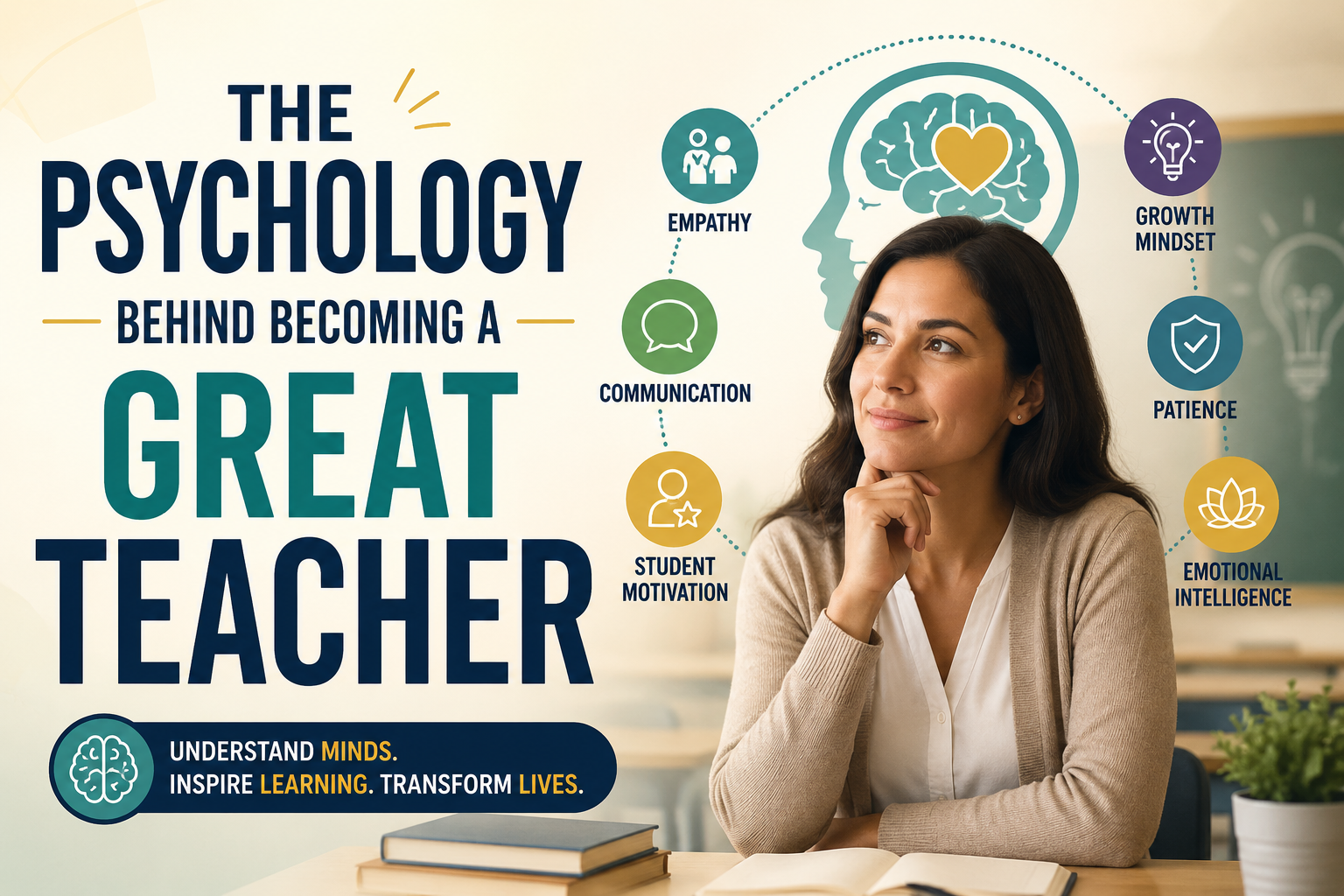
Teaching is often seen as the simple act of delivering knowledge, but in reality, it is deeply rooted in psychology. Every classroom is shaped by emotions, attention, memory, motivation, and behavior—factors that decide how effectively a student learns. The difference between an average teacher and a great teacher is not just subject expertise, but the ability to understand how the student’s mind works. This blog explores the psychology behind becoming a great teacher—how emotional intelligence, attention management, communication, and motivation shape learning outcomes. It reveals why understanding student behavior, building trust, and creating psychological safety in the classroom can transform ordinary teaching into a powerful learning experience. Because at its core, great teaching is not about what is taught, but how the mind receives and processes it
Teaching is often seen as a profession of knowledge delivery—where the teacher explains and the student absorbs. But in reality, teaching is deeply psychological. Every classroom is a living system of emotions, attention, memory, behaviour, confidence, and curiosity working together at the same time.
A teacher may explain the same concept to two students, but one understands it instantly while the other struggles. The difference is rarely intelligence alone—it is psychology.
“Great teaching doesn’t start with what you teach—but how the mind receives it.”
To become a great teacher, understanding how students think is more important than what is taught.
Students differ in:
A student who is anxious or distracted cannot learn effectively, even with the best explanation. Similarly, pressure may produce short-term results but weak long-term understanding.
Motivation plays a much stronger role than fear. When students feel encouraged, they learn faster, remember longer, and participate more actively.
Great teachers are not just subject experts—they are emotionally intelligent guides.
This includes:
Instead of labeling students as “weak” or “careless,” great teachers try to understand the reason behind behavior. This shift in mindset completely transforms classroom outcomes.
Attention is the gateway to learning. Without it, even the best lesson fails.
Students lose focus due to:
Great teachers use psychology to maintain attention:
The brain responds strongly to curiosity and reward. When learning feels interesting, dopamine increases, improving engagement and retention.
Memory is not about repetition alone—it is about meaningful understanding.
Students retain information better when:
A great teacher doesn’t just teach answers—they help students build mental connections that last longer than exams.
Motivation is the invisible force behind learning success.
There are two types:
Great teachers focus on building intrinsic motivation by:
When students feel capable, they naturally perform better.
Classroom behaviour is often misunderstood as discipline issues, but it is deeply psychological.
Students may act out because of:
A strong teacher maintains balance between authority and friendliness. Too strict creates fear; too lenient reduces respect. The ideal classroom is one where students feel safe, yet guided.
Psychological safety encourages participation, mistakes, and learning.
How a teacher communicates is often more powerful than what is taught.
Key factors include:
Simplifying complex ideas is also a psychological skill. When students feel “this is easy to understand,” their resistance drops and learning increases.
Trust is built not through perfection, but through consistent, respectful communication.
Great teachers share certain psychological traits:
They understand that teaching is not static. Every batch of students is different, and effective teaching requires continuous learning from feedback and experience.
Teaching is not just an academic profession—it is a human science that blends psychology, communication, empathy, and knowledge.
A great teacher does not only prepare students for exams—they shape how students think, react, and grow in life.
In the end, teaching is not about controlling a classroom—it is about understanding minds.
When you understand the mind, you don’t just teach—you transform lives.
